Occasionally I write software to try to help people. https://www.dontarrestme.net/ is one example. This time I’m writing something just for me, although, perhaps, it might help other people too.
I listen to a lot of Japanese music and I don’t speak Japanese, I know a tiny tiny bit of romaji and an even smaller bit of the three character sets (old words, normal words and borrowed words are written differently!). I can hear the mora timing in the songs I listen too. I absolutely love when NMU and others flip in an English word that fits the mora of their Japanese surrounding it. So skillful. Mora is the smallest unit of timing in speech, it represents a single beat. It’s not like syllables which can vary in length, each mora is approximately the same duration, it makes up the key element in the rhythm of Japanese pronunciation.
How do we pronounce Japanese written as romaji? Turns out, as far as I can understand, Japanese has only 5 vowel sounds, and they’re pure and consistent — they never change based on context unlike English vowels which are all over the place:
a = “ah” (like in “father”, never like “cat”)
i = “ee” (like “feet”, short)
u = somewhere between “oo” and “uh” — lips unrounded, almost whispered
e = “eh” (like “bed”)
o = “oh” (pure, no English diphthong slide)
So we can read romaji with those five sounds consistently and be largely understood.
Where I go wrong, and I think this is an English speaker thing…
The u is the killer. English speakers say “oo” — Japanese u is unrounded and often nearly silent. desu is pronounced “dess” not “deh-soo”. akiramenai — that final i is also often whispered down to almost nothing.
R is its own thing entirely — it’s not an English R or an L, it’s a single tap like the Spanish r in pero, or the d in the American pronunciation of “butter”. English R probably sounds alien to Japanese ears.
Pitch accent is the thing makes me sound weird even when technically correct. Japanese isn’t tonal like Mandarin, but it has pitch accent — syllables are high or low, and the pattern matters. hashi can mean chopsticks, bridge, or edge depending on pitch. What is this?!! Let me elaborate. Go visit Real Real Japan - YouTube then come back here. Kaeru Kaeru Kaeru 🐸🐸🐸 #learnjapanese #japaneseculture
Romaji gives you zero information about this. You absorb it from listening, which is exactly why learning from the music I already know might genuinely be advantageous — I am already internalising the pitch patterns without realising it.
Long vowels (often written with a macron — ō, ū) are just held longer, but English speakers habitually shorten them. 自由 jiyū — that ū matters. This is the opposite of u.
Bottom line: read romaji literally with those 5 pure vowels, tap the R, whisper the weak vowels, and you’ll be understood and not too offensive to the ear ;)
I am listening to tons of Japanese with no clue what the words mean but with some idea on how it all holds together as I said in
I am outside the room enjoying the sound but I’m outside so I have decided to teach myself Japanese starting with making a flash card system based on the lyrics I hear.
I don’t want to be stuck outside feeling like
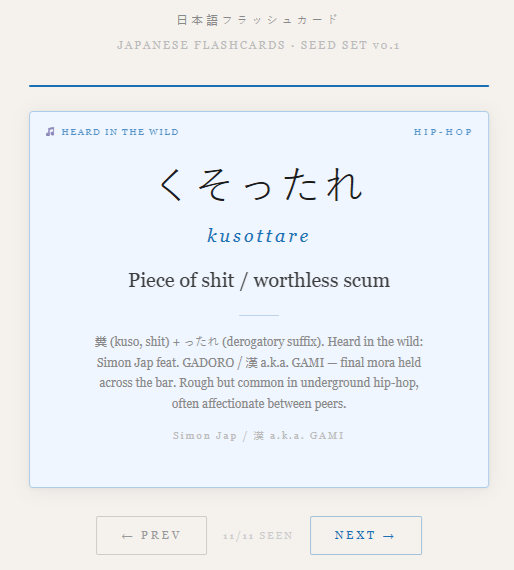
So here I am doing it my way…
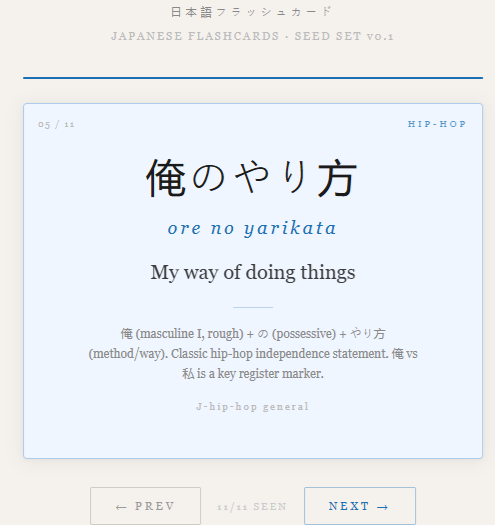
Because
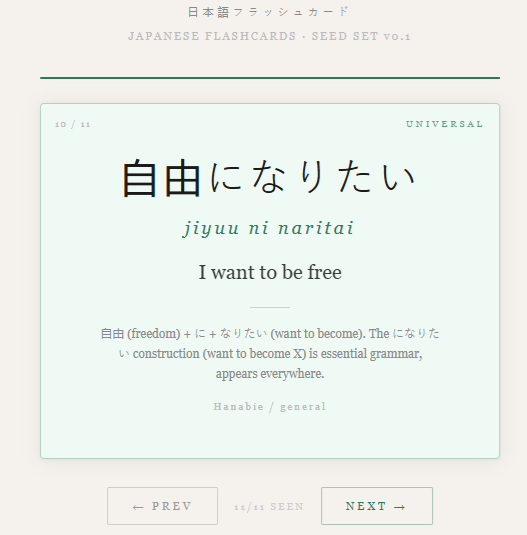
No idea if it will work but I feel like an Oni whose just been given an iron club (if you know, you know).