There’s a moment I keep coming back to. I’m on the A27 — that particular stretch of roundabout purgatory heading west, where the only rational response to the Polegate junction at any time of day is to turn the music up loud and commit — and something comes on shuffle that stops my internal monologue dead. A voice. Impossible range, absurd power, delivered with the casual authority of someone who has no idea they’re doing something that shouldn’t be physically possible. My brain, reaching for the nearest reference point it has for this category of thing, produces a single word.
Dio.
I’m thinking about Ronnie James Dio. In 2024. Because of a twenty-something Japanese woman who started posting covers on NicoNico as a teenager.
I pulled over and googled her. That’s how I found Ado.
I should give you some context about where I was coming from, because the arrival only makes sense against the background of what I’d almost given up on.
I’ve been in live music rooms my whole life. Decades in the London alternative scene — the Slimelight, the Bull and Gate, the Intrepid Fox before it became a Pret — standing in the dark while something loud and committed happened at the front of the room. I know what it feels like when music has that quality. That un-ironic physical commitment to the thing being made. That sense that the people on the stage are somewhere between craft and possession and they couldn’t stop if they wanted to.
British music still does that. But you have to look harder than you used to. The folk scene keeps the faith. Wolf People carried it. Green Lung carry it now. But they’re islands in something that has become, largely, clever and self-aware and retrospective. Excellent, often. Alive in that specific way, less so.
Part of this is structural and we don’t talk about it, well, not often. So many venues are gone, or going. The licensing changes that made live music in pubs a bureaucratic ordeal rather than a Thursday night. The noise complaints that closed small venues and live rooms. Neighbors of The Dublin Castle in Camden tried to shut them down, and thankfully failed, but we didn’t just lose places — we lost the pipeline. Not all of it but enough to hurt. The place where someone with something extraordinary happening in their voice gets heard before anyone decides whether it’s commercially viable. Before anyone decides what it is.
Japan kept that pipeline. NicoNico — the platform where musicians post covers, originals, collaborations, experiments, all of it — is where Ado found an audience before she had a record deal or a brand or a carefully managed rollout. It’s where a generation of musicians learned their craft making music for synthetic voices in the vocaloid community, developing a technical precision and a willingness to attempt the genuinely difficult that you can hear in everything they subsequently made. The infrastructure for talent to be discovered sideways, horizontally, by other music people rather than by industry — that still exists there. We used to have it. We let it go, one noise complaint and one licensing renewal at a time.
So when I pulled over on the A27 thinking about Dio, I wasn’t just discovering a singer. I was discovering what the other end of a functioning ecosystem sounds like.
I didn’t fall into it neatly. It wasn’t an algorithm serving me a tidy gateway. I pulled threads. Ado led somewhere, and that somewhere led somewhere else, and then I ran straight into Hanabie. and it was, as the kids say, game over.

Consider this for a moment: Hanabie. are four young women who perform with the energy of a structural fire. Their music shouldn’t work on paper — the tempo changes, the tonal lurches, the way a song will pivot from something genuinely pretty into something that wants to physically displace you — and live it’s one of the most joyful things I’ve seen in a room in thirty years.
I use that word deliberately. Joyful.
I saw them at Electric Brixton. Walking from the tube I started noticing the t-shirts — one, then three, then a whole tribe materialising out of the Brixton evening, converging on the same place with the particular purposeful energy of people who know exactly why they’re here. I’ll be honest: for a moment I wondered if I was going to be the weird old geezer. The one who doesn’t quite fit. The one the room tolerates rather than welcomes.
The mosh cleared that right up.
Because somewhere in the middle of it, grinning like an absolute idiot, I was back. Not metaphorically. Physically back, in my body, in a room, in that specific quality of shared chaos that I hadn’t felt since — and this is where it gets strange — since Jane’s Addiction at the Astoria.
Their last show before the first breakup. I danced so hard my legs gave out. As I went down, a hand appeared from somewhere in the dark and grabbed mine and pulled me back to my feet. I never saw whose hand it was. I struggled out to the edge of the room and just sat with it for a while, the way you do when something has taken everything you had.
I thought about that hand in the Hanabie. mosh. Thirty years and a language I don’t speak and there was the same room, the same quality of abandon, the same thing happening between people who’d never met and would probably never meet again. The fans, by the way, are awesome. Whatever you think Japanese music fandoms are like, they’re warmer and more inclusive and more genuinely joyful than that. The weird old geezer from East Sussex was fine. Better than fine.
That quality in Hanabie. — the chaos, the joy, the uncontained thing — it’s the same quality I remember from the best late seventies punk and metal, before the genre machinery arrived and started sorting everything into boxes. It isn’t nostalgia. It isn’t retro. It’s just what music sounds like when nobody’s told it yet what it’s supposed to be.
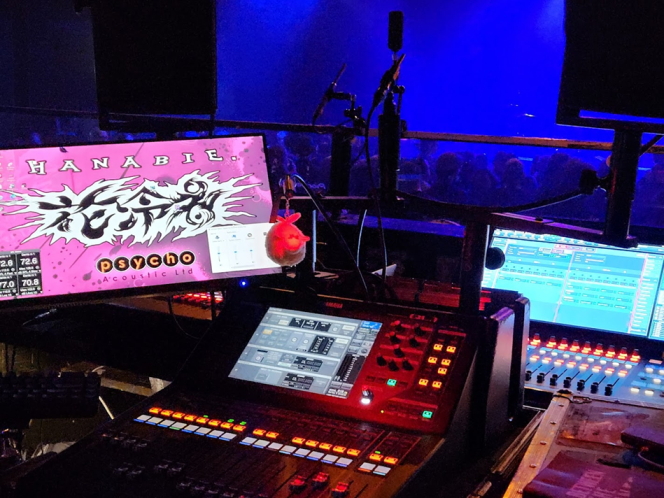
Then Nemophila. If Hanabie. is chaos finding its form, Nemophila is technical excellence wearing a grin. They’re a band who could clearly do almost anything they wanted musically, and what they want to do is hit very hard and very accurately, with enormous craft and zero pretension. RAITEI was my most-played track last year. I don’t know what most of the words mean. I know exactly what it means.
That’s the thing I keep trying to explain to people and keep failing to explain adequately.
I don’t speak Japanese. My comprehension is essentially zero beyond the basics that leak through from years of watching films. And yet I am listening to this music differently — more carefully, more physically — than I have listened to anything in years.
When Nyxen delivers a line with that extraordinary precise articulation — and if you haven’t heard her, imagine someone who treats consonants like they owe her money — the hairs on the back of my neck go up before my brain has processed anything semantic. The meaning, whatever it is, arrives second. The fact of it arrives first. There’s something clarifying about having the linguistic processing lane taken out of the equation. You receive the music more directly. The emotion isn’t mediated through what the words say. It just lands.
There’s grief in this too, and I want to be honest about that. There’s a room I’m standing just outside. When Ice Bahn or Gaki Ranger or Nitro Microphone Underground are in full flow — and if you think you know what Japanese hip-hop sounds like and you haven’t heard NMU, you don’t know what Japanese hip-hop sounds like — I can hear the craft, feel the energy, trace the lineage back through Cypress Hill and De La Soul and the whole dense tradition of what people did with breath and rhythm and a beat to spar with. I grew up with that music. I know the shapes of it. And I’m hearing those shapes made new in a language I can’t follow, simultaneously completely familiar and permanently slightly out of reach.
And then something like HALCALI comes on during a walk home on a bank holiday afternoon — 燃えよハルカリ with Mummy-D, which is a completely different animal, all bounce and chaos and barely contained absurdist joy — and any worry evaporates and you’re just grinning at the pavement again. This valley I’ve found contains wonders. NMU’s dense layered precision and HALCALI’s joyful derangement are not contradictions. They’re the same ecosystem expressing itself in completely different directions at once.
That’s not a small thing. I’m not going to pretend it is.
But — and this is the part that surprised me — the not-understanding is also a gift. It strips something away. The music stops being something I’m half-reading and starts being something I’m fully in.
My Spotify Wrapped last year told me I’d listened to 43,052 minutes of music. Top five artists: Nemophila, Hanabie., Maximum the Hormone, Babymetal, Band-Maid. Top genre: J-Rock. I am the 346th most dedicated Nemophila listener on the planet (well Spotify at least!), which I’m choosing to be proud of rather than concerned about.

There’s a playlist on my phone called You listen to this? Oh, yes, yes I do. It has NMU next to Nyxen next to Awich next to Shojo no Yurei next to PaleNeØ next to Broken By The Scream. It covers about eight genres and three decades of influence and it plays like a single coherent argument about what music can be when nobody’s told it what it’s supposed to be yet. When I say coherent I may mean in an especially discordian way.
That’s the valley I found. You climb for a while — through the roundabout purgatory of the A27, through British music that is excellent and bloodless, through the slow realisation that what you’re hungry for still exists somewhere — and then you come over a ridge and there it is. Full of crazy people and energy and four young women in Electric Brixton who just gave you back something you’d lost at the Astoria thirty years ago.
Someone grabbed my hand in that mosh and pulled me to my feet. I never saw who it was.
In a way, they all did.
If you’ve read this far and want somewhere to start: Ado — New Genesis. Nemophila — RAITEI. Hanabie. — TOUSOU. Nitro Microphone Underground — ASAMA131. Nyxen — Butaishō. Ice Bahn — GYPSY. HALCALI — 燃えよハルカリ (feat. Mummy-D). Then follow the threads. The valley is bigger than it looks from the path.
There is a companion Spotify playlist. It contains Maximum the Hormone. You’ll know when you get there. You have been warned. Here’s two playlists… enjoy!
Also many thanks are owed by me to Real Japanese Aesthetics for inspiring me to write about my journey up the mountain to find such amazing music, musicians and a vibrant scene. OSS!