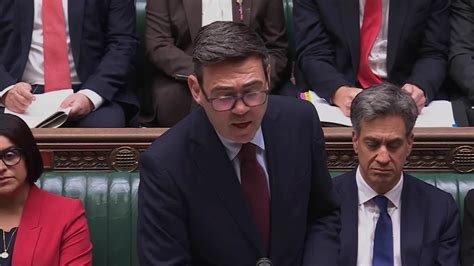
What was actually said
At Prime Minister’s Questions, Kemi Badenoch proposed taking roughly £4bn out of housing benefit to help fund defence spending. Andy Burnham rejected the idea telling MPs that the government supports national security fully, but that it cannot come at the expense of social security. He add that real national resilience also depends on stable, supported communities.
He wasn’t really saying “benefits always beat security” but rather an inept way of saying “don’t fund defence by raiding welfare.” But the underlying logic he reached for to justify it needs looking at, because it’s a position politicians return to often, and, frankly it’s wrong. That’s what this piece is all about.
Why the framing is wrong
Burnham’s line treats defence and welfare as two ordinary budget lines competing for the same pot, a normal trade-off between goods. They aren’t equivalent goods and here’s why:
Precondition, not competitor. A welfare state is something the state produces. Producing anything requires the state to keep existing. Security is what guarantees that continued existence, against invasion, coercion, or internal collapse. Weighing it against benefits like it’s just another spending priority is a category error as you can’t trade a foundation against the thing standing on it and making that error says quite a lot about the quality of our politicians.
Asymmetric recoverability. Underfund welfare for a decade and it can be rebuilt, you can raise revenue, borrow, and restore provision. Lose a war, get invaded, or lose the state’s monopoly on internal force, and the institutions needed to run any welfare system be they the courts, tax collection, currency, administration can easily take a generation to recover, or never actually recover in a persons life time. That’s once hell of a gamble to be taking with all our lives.
The insurance analogy. Nobody skips house insurance to afford nicer furniture, because the furniture is worthless once the house burns down. Defence is the premium on the asset that makes every other budget line possible.
The philosophy behind his position, and its real merit
Burnham’s underlying idea isn’t entirely empty. The claim is that security isn’t purely a military category: social cohesion, low inequality, and community resilience reduce radicalisation, strengthen the recruitment base, and build public trust which is itself a component of national resilience against internal and hybrid threats. On this view, “benefits vs. security” is a false dichotomy, because well-supported communities are part of the security picture, not a rival to it. This is a legitimate strand of security thinking, not just political cover. There is a real irony however because right now in Britain the tax payers are getting more and more fed-up with funding the benefits as they see that the institutions of state are misdirecting funds (from the general populations perspective) to all sorts of ideologically motivated projects, and at the same time the state is implementing a form of soft totalitarianism to control the more and more pissed off populace. If Andy wants to rebuild our society there are better ways of doing it than the benefits system which, frankly, is making things worse in some ways. For a start he should look at https://substack.com/@charlottegill and cancel all the funding projects she finds and use that money to fund the MOD shortfall.
Where it breaks down
The argument only really works if defence is already adequately funded and the marginal pound genuinely does more for resilience via welfare than via hard capability. That’s an empirical claim, not a given, not a ‘this side of the house will always’ position and by using it, it quietly assumes away the actual risk.
If you underfund (we have) the military to the point where it’s no longer capable of deterring or repelling an actual threat, the “resilient communities” argument collapses along with everything else it depends on. Social cohesion doesn’t stop tanks. A well-supported population under occupation, or a state that has lost a war, doesn’t get to keep its benefits system intact because its communities were resilient. It loses the capacity to run any system, welfare included. The soft-power case for social investment as security is only coherent below the threshold where hard capability fails; above that threshold, it isn’t a trade-off anymore, it’s a bet on never needing the military you didn’t fund.
Example of underfunding the MOD
Modern day Threat Models
Improving the Benefits System
Fixing Growth
and the Sequence is key