I fairly recently joined substack and write about the state of the British economy, our military, our government, our energy policy, and, from time to time about a place I discovered entirely by accident thanks to Spotify. I discovered female Japanese metal bands and never looked back. It led to all sorts of other musical discoveries as well as learning more about Japan as a whole. Albeit from the UK, as a grey beard.
Then I came across Nostalgia Japonica - Real Japanese Aesthetics who writes amazing articles about their experience of actually living in Japan as a Gen Z creative. She recently wrote an article about a scandal about medical schools in Japan quietly marking down female applicants. Of course, being an old grey beard, this is about as far away from my experience as I could get but I started reading about it, and trying to correlate it with my tiny tiny view into Japanese culture where women are clearly leading the charge musically, at least, based on what I listen too!
In 2018, an internal investigation confirmed what a generation of women in Japan had probably already suspected. Tokyo Medical University had spent years quietly altering its entrance exam scores — deducting points from female applicants and, in at least one cohort, adding twenty points to the scores of men who hadn’t failed too many times. The stated logic, when it finally surfaced, was almost banal in its cruelty: women, the administrators reasoned, would marry, have children, and leave medicine, so it was tidier to keep their numbers down to around thirty percent. The lawyers who ran the investigation called it “profound sexism.” They were being generous. It was profound sexism executed with a spreadsheet.
This wasn’t a slur shouted across a room, not a glass ceiling you bump your head on by accident — a deliberate, multi-year, institutionalised arithmetic, designed to convert merit into the wrong answer if you happened to be a woman. The young women sitting those exams had done everything right. The system had simply decided, in advance and in secret, that “right” wouldn’t be enough for them.
That scandal is the clearest possible illustration of the machinery women in Japan have been navigating: not always overt hostility, but a quiet structural assumption about where they belong and how long they’ll stay. It shows up in the pay gap, in the thin representation in corporate leadership and politics, in the expectation that ambition is a phase you grow out of when you grow up. The medical school just happened to write it down.
And yet.
There is one arena where this machinery seems to have consistently failed to hold, where Japanese women have not merely participated but dominated, set the terms, and built institutions of their own. That arena is the stage.
The lineage nobody can argue with
Show-Ya formed in the early eighties and spent the decade proving that an all-female Japanese hard rock band could be ferocious rather than decorative — not an idol act assembled by a label, but musicians who wrote and played with teeth. I think their real masterstroke wasn’t a single record, though. In 1987 they launched Naon no Yaon — roughly “Women’s Field Festival” — an all-female event at Hibiya Open-Air Concert Hall. At the precise moment the working world was quietly rationing women’s opportunities, a group of women built their own venue, their own bill, their own institution, and simply got on with it. Naon no Yaon still runs, and the bands carrying the current wave have played it.
Because there is a current wave, and it is extraordinary. Lovebites, Nemophila, Aldious, Mary’s Blood, Bridear — technically blistering, internationally touring, and crucially musician-led. This is the part that matters. The contrast isn’t between “women in music” and “no women in music.” Japan has always made space for women to perform. The shift is in who holds the controls. The old model handed women a microphone and kept the songwriting, the image, and the business decisions somewhere else. The new model has the women writing the riffs, running the project, and deciding what it means and being front-and-center at the end of the gig.
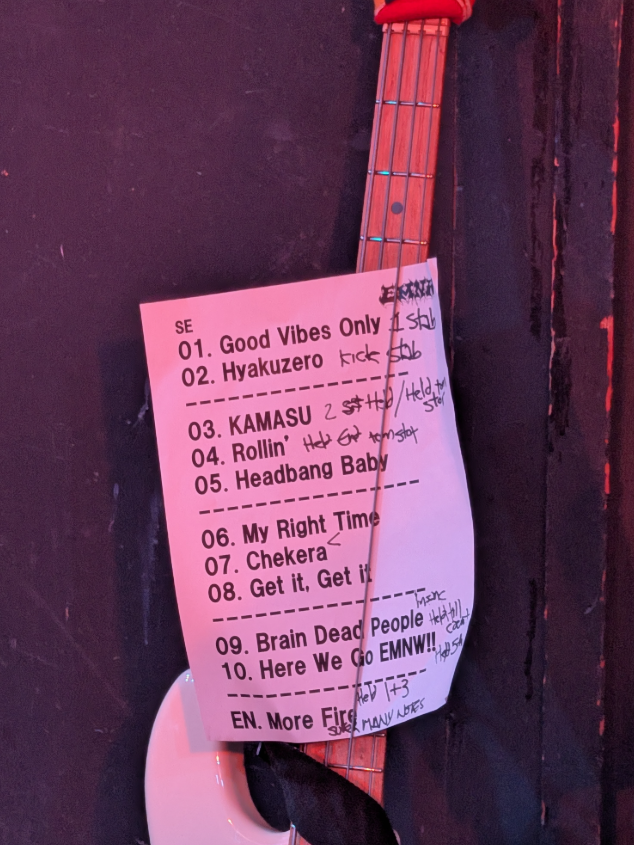
I went to a EMNW gig in London a few weeks ago. Two women leading it (Emma and Menu), one of their mums (I think) crewing with them, and a team of guys backing them up. None of them, I think, really believing there they were in London (I can’t believe I saw their first tour here).

When the songs say it out loud
What makes this moment sharper than mere virtuosity is that some of these bands have started naming the constraint directly — turning the daily friction of Japanese social life into the actual subject of the music.
Hanabie. are the obvious example, and their best-known track is almost a thesis statement. “お先に失礼します” — rendered in English as “Pardon Me, I Have To Go Now” — takes one of the most loaded phrases in Japanese office life, the ritual apology you make for daring to leave work before your colleagues, and detonates it. The song is about being crushed under a calendar of obligations, the endless peko-peko bowing and deference, the small talk you don’t fit into, the suspicion that you’re being treated like a child — and the longing to simply run. It dresses this up in Harajuku colour and metalcore aggression, which is exactly the trick: the rage is real, but it arrives grinning. Elsewhere in their catalogue they’ve gone at NEET culture and the pressure to perform femininity on schedule. The aesthetic is candy; the content is a pressure valve.
That’s the pattern worth noticing across the scene. The front women of bands like Nemophila and acts like Nyxen sing, in their own registers, about non-conformity and the cost of being a woman who refuses to shrink. The lyrics describe the same walls the medical school built — the assumption that you’ll quit, the expectation that you’ll defer, the sense that the rules were set before you walked in.
The contradiction is the fuel
So what’s going on here? Why does a society that ranks so poorly on workplace and political parity produce, almost defiantly, this density of self-determining female bands?
Just consider this: the two facts aren’t in tension. They’re the same fact, viewed from opposite ends. The constraints women describe in the lyrics are precisely what make a virtuosic, self-governing, all-female band read as a statement rather than just an evening’s entertainment. In a context where the spreadsheet has already decided you’ll leave, staying — loudly, expertly, on your own terms — is the argument. Show-Ya proved, four decades ago, that the thing could be done at all. The gender environment is what keeps it meaning something every time it’s done again.
There’s a caveat I’d want to keep honest about, and it’s this: it is far too easy, especially from outside Japan, to read every lyric as autobiography and flatten a dozen very different artists into a single tidy “defiance” narrative. These are individuals with their own intentions, and not all of them are writing manifestos — some are just writing great songs and would resist the framing entirely. The point isn’t that every Japanese woman with a guitar is a protest singer. The point is structural: the door that the medical school, and a thousand quieter institutions, kept trying to close is the one door performance left open. And women walked through it, picked up instruments, and built a stage that nobody managed to gatekeep. Perhaps Japan, as a whole, should take note of this and, you know, let women get on with being bloody brilliant in other roles too?
When Show-Ya stood up in 1987 and put their own festival on, a teenage girl somewhere in Japan, facing a future being quietly downgraded in someone else’s arithmetic, got to watch women decide for themselves what they were allowed to be. That’s not a small thing. That might be the whole thing.
Go see who started it and give them a subscribe