There is, in the annals of British bureaucratic achievement, a particular genre of scandal: the one where the data was right there, plain as day, and absolutely nobody acted on it. Windrush. The Post Office. Contaminated blood. The Rape Gangs. Now, apparently, we can add lawyers charging thousands of pounds to coach straight men to claim they are gay so they can stay in the country to the list.
The BBC — in what must be acknowledged as a rare return to form — published the results of an undercover investigation this week that found a functioning commercial network of immigration law firms and advisers operating what one might charitably call an identity optimisation service. Less charitably: systematic fraud on the British state, at scale, for profit, over a period years, possibly decades.
The scheme is not complicated, and I remember a London friend telling me years ago, the problem with immigration is the amount of money lawyers are making from it. It appears he was 100% right. So, the scheme; A Pakistani or Bangladeshi national whose student visa is approaching expiry visits one of several law firms. For fees ranging from £1,500 to £7,000, they are provided with a fabricated backstory, coached on how to obtain supporting evidence — staged photographs at LGBTQ+ events, letters from people willing to attest to a sexual relationship that did not occur, and in some cases GP documentation obtained under false pretences — and then assisted in lodging an asylum claim on grounds of sexual orientation. One adviser boasted she had been doing this for seventeen years. Another cheerfully offered to arrange a fake gay partner. An undercover reporter was told his wife in Pakistan could follow him over once he secured asylum, and then make her own claim — as a lesbian.
“I am a gay and it is my reality,” one adviser coached their client to say.
It is, one has to concede, a memorable script.
The Charges That Should Follow
Let us be precise about what the law says, because this matters.
The lawyers and advisers caught on camera are not operating in a grey area. They are not pushing the boundaries of legitimate legal practice. They are, on any reasonable reading of the statutes, committing multiple serious criminal offences simultaneously.
Section 25 of the Immigration Act 1971 makes it a criminal offence to knowingly facilitate a breach of immigration law. It carries a maximum sentence of fourteen years. It does not require the facilitator to be present at the asylum interview, or to lie personally to the Home Office. Facilitating suffices.
The Fraud Act 2006 provides two further hooks. Section 2 — fraud by false representation — covers knowingly causing a false representation to be made to a public authority, which is precisely what coaching a straight man through a fabricated sexual identity claim achieves. Section 4 — fraud by abuse of position — speaks directly to a solicitor who owes duties to the court and to the administration of justice, and who weaponises that position for commercial gain. The fee makes it worse, not better.
The Serious Crime Act 2007, sections 44 to 46, criminalises intentionally encouraging or assisting the commission of an offence. The client is committing fraud. The lawyer is not merely watching. They are writing the script.
The Proceeds of Crime Act 2002, section 328, catches anyone who becomes concerned in an arrangement they know or suspect facilitates the handling of criminal property. The fee — thousands of pounds per fabricated claim — is criminal property.
The appropriate investigators are the National Crime Agency and the relevant Regional Organised Crime Units, with the Solicitors Regulation Authority moving simultaneously to intervene in the named firms. Named firms exposed by the BBC include Law & Justice Solicitors and Connaught Law. A paralegal at Law & Justice was also identified as the founder of Worcester LGBT, a support organisation for gay and lesbian asylum seekers which appears to have been functioning, at least in part, as a pipeline for fabricated supporting evidence.
Worcester LGBT has since confirmed it has permanently removed the individual in question. The firms have yet to confirm anything so definitive.
The Number Nobody Asked About
Here is where the piece acquires a different character.
The BBC’s investigation also surfaced Home Office data. In 2023, there were 3,430 initial decisions on LGBT asylum claims and nearly 1,400 new claims based on sexual orientation. Of those, 42% were lodged by Pakistani nationals — despite Pakistanis representing only 6% of total asylum applicants and ranking fourth by nationality overall.
Let’s pause for a moment and think about that. Forty-two percent of one specific protected-characteristic claim type, from six percent of the applicant pool.
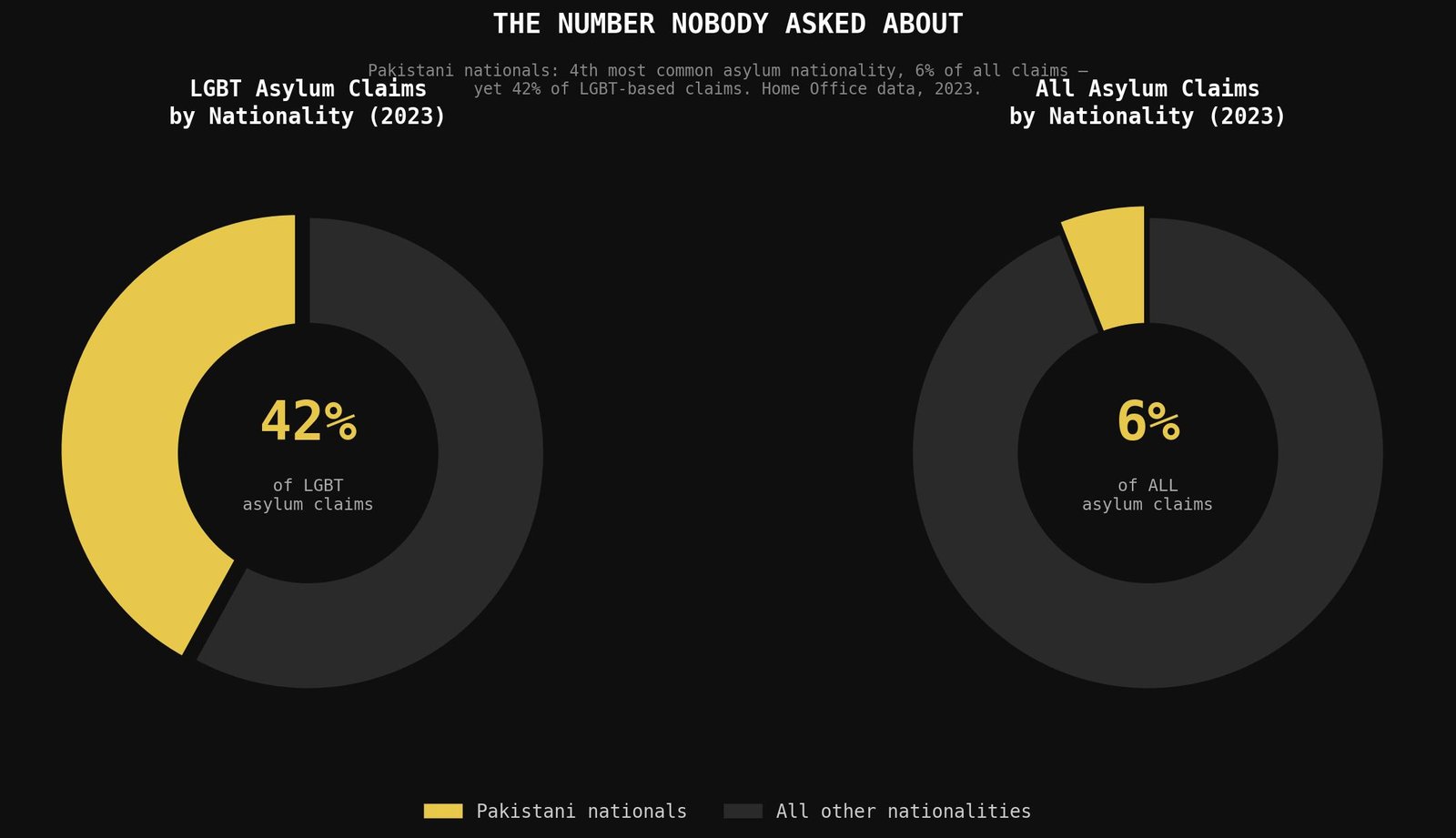
This is not a subtle statistical anomaly. I made it ludicrously BIG so you can clearly SEE it’s not a statistical anomaly.
This is the kind of number that falls out of any routine data quality review. Any analyst running variance reports on claim-type distributions across nationalities would have seen it. The question — the one that now requires an answer — is what happened next.
The Home Office responded to the BBC’s findings by stating that anyone found trying to exploit the system would face “the full force of the law.” This is reassuring boilerplate. What it does not address is whether anyone inside the Home Office had previously identified this distribution, escalated it, and been told to leave it alone — or simply filed it somewhere quiet and moved on.
That question matters because the answer determines whether we are dealing with institutional negligence or something considerably more deliberate.
The Fox, The Henhouse, and the Chain of Command
Here is the structural problem with investigating it.
The Police report to the Home Secretary. Border Force and Immigration Enforcement are not arm’s-length agencies — they are directly part of the Home Office. The National Crime Agency, which has the most appropriate jurisdiction for this kind of organised fraud, has its strategic priorities set by the Home Office. Even the Independent Office for Police Conduct, which investigates police misconduct, operates within a framework the Home Office shapes.
If suppression of inconvenient data occurred at Home Office level, every obvious investigative body either reports into the department, is funded by it, or owes its mandate to it.
The prosecution chain is no cleaner. Criminal prosecutions of the seriousness required here — particularly any that might touch on misconduct in public office by officials — would require Crown Prosecution Service involvement. The CPS answers to the Director of Public Prosecutions. The DPP answers to the Attorney General.
The Attorney General is Lord Hermer.
Lord Hermer is a life peer created specifically to fill the role — the first Attorney General in over a century not to have previously served in Parliament — appointed by Keir Starmer, his former colleague at Doughty Street Chambers, following Labour’s 2024 election victory. He donated to Starmer’s 2020 leadership campaign. His legal career was built predominantly in human rights and international law. His foreign policy framework, which he has articulated publicly, aligns with the “Progressive Realism” paradigm articulated to the Fabian Society by David Lammy, the Foreign Secretary. Lord Hermer’s name appears in analyses of ministerial Fabian affiliations.
The Fabian Society, for readers unfamiliar with it, is the gradualist socialist intellectual society that has shaped Labour policy since the late nineteenth century. Its foreign policy disposition is internationalist. Its historical view of immigration is broadly expansionist.
These are facts. The reader may draw their own conclusions about the institutional appetite for a prosecution that might, if pursued vigorously enough, require explaining why a forty-two to six percentage point disparity sat unactioned in Home Office data for years under successive administrations — and whether the current one has any interest in finding out.
The Harm to the People This Was Meant to Protect
This would be a simpler story if the only victims were the British state and the taxpayer. They are not.
The LGBT+ asylum route exists because persecution on grounds of sexual orientation is real, serious, and in many source countries carries the force of criminal law. Pakistan criminalises same-sex conduct. Bangladesh does the same. For a gay man or lesbian woman fleeing genuine persecution, the asylum system is not a bureaucratic convenience. It is the difference between safety and being returned to danger.
The credibility assessment process for sexual orientation claims is already gruelling and frequently dehumanising. Applicants are asked to prove something that is, by its nature, private. The process is under constant pressure — from advocacy groups on one side arguing it is intrusive and discriminatory, from sceptics on the other arguing it is too easily gamed.
Systematic fabrication of claims by a commercial network does not merely defraud the state. It corrodes the credibility of every genuine claimant. It gives ammunition to those who wish to restrict or eliminate the route entirely. It makes the assessors more suspicious, the process more adversarial, and the outcomes worse for the people who actually need it.
The adviser who has spent seventeen years coaching straight men through fake gay asylum claims has not spent seventeen years helping the LGBT+ community. She has spent seventeen years making life harder for them.
Threading the Needle
For those who wish to see genuine accountability, the realistic path is narrow but it exists.
The BBC footage is evidential. It does not require a whistleblower. It does not require a client to give evidence against their lawyer. It is what it appears to be. The NCA and relevant ROCUs should be opening files on the named individuals and firms immediately, and the SRA should be intervening in those practices in parallel.
On the question of what was known and when inside the Home Office, the lever is Parliament. The Home Affairs Select Committee has genuine investigative powers. It can compel witness attendance and document production. It does not answer to the Home Office. A committee member with sufficient determination could demand the internal reporting record on LGBT claim distributions by nationality going back five to ten years — which meeting minutes it appeared in, what recommendations were made, and what decisions were taken.
That disclosure either exonerates the department or it does not. Either outcome is informative.
The deeper accountability question — whether the prosecutorial chain has the independence and the appetite to follow evidence wherever it leads — is one that the current composition of government makes structurally difficult to answer in the affirmative. That is not an accusation. It is a description of the architecture.
If a future government chooses to revisit the question with fresh eyes and a less conflicted chain of command, the evidence will still be there. Data does not delete itself. Neither does seventeen years of caseload.
The offence of misconduct in public office is a common law offence carrying a maximum sentence of life imprisonment. It requires a public officer, wilfully neglecting their duty or wilfully misconducting themselves, to a degree that amounts to an abuse of the public’s trust. It is not often charged. It is not unchargeable.
Some other context: