“So soon as ever your mazed spirit descends From daylight into darkness, Man, remember What you have suffered here in Samothrace, What you have suffered.
After your passage through Hell’s seven floods, Whose fumes of sulphur will have parched your throat, The Halls of Judgment shall loom up before you, A miracle of jasper and of onyx. To the left hand there bubbles a black spring Overshadowed with a great white cypress. Avoid this spring, which is Forgetfulness; Though all the common rout rush down to drink, Avoid this spring!”
— Robert Graves, Instructions to the Orphic Adept
It was gone 1am when this poem surfaced. Not because I’d been reading Graves — I hadn’t, not that evening. Something else had been turning, somewhere below the threshold of whatever passes for organised thought at that hour, and it brought me here. To this poem. To this fork in the road.
Consider that for a moment, because it matters, and we all do it and we’ll come back to it later.
The Poem and the Man
Robert Graves (1895–1985) is most widely remembered for I, Claudius and Goodbye to All That, his searing memoir of the First World War. But the work that consumed the deeper part of his life was something stranger and more obsessive — a sustained engagement with mythology, the pre-Olympian goddess religions, and the nature of poetic inspiration itself. The White Goddess (1948) is the theoretical framework; The Greek Myths (1955) is where he handles the classical material in characteristically maddening, brilliant, frequently wrong, and occasionally visionary detail.
Instructions to the Orphic Adept sits at the intersection of Graves the poet and Graves the mythographer (a word that we need to use more and have more people being one!) What makes it extraordinary is the stance he takes toward his source material: he treats it as operational. Not metaphor, not charming antiquity — actual instructions for actual use. Most classicists of his era (and many since) regarded the Orphic tablets as curious relics. Graves read them as a manual, as a standard operating procedure.
He was, I think, correct.
The Petelia Tablet
In the British Museum, in a case that doesn’t get nearly the visitors it deserves, sits a thin sheet of gold leaf approximately the size of a business card. It was found near Petelia in southern Italy, dates to the 4th century BCE, and was buried with its owner — folded, placed in a small gold capsule, worn around the neck in life and interred in death.
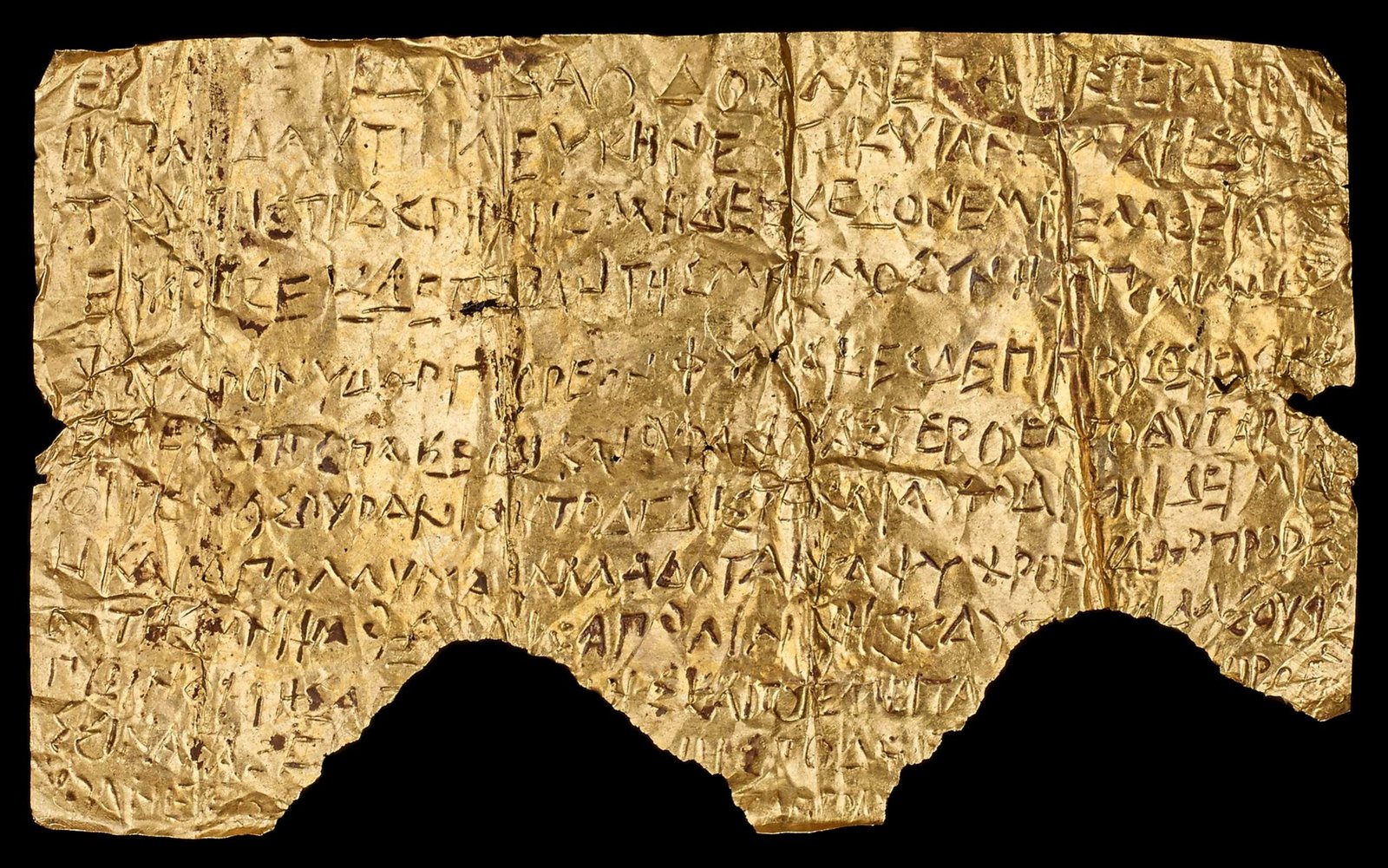
It is a set of directions.
The soul, newly arrived in the underworld after passing through what Graves renders as seven sulphurous floods, faces a choice.
To the left: a spring beside a white cypress.
To the right: the Lake of Memory — Mnemosyne (Μνημοσύνη) — cold water, flowing, guarded.
The white cypress is the trap. It looks like relief. It looks like what you need when you are parched and disoriented and the last thing you remember is dying. The main character in a Isekai anime would probably make the mistake. The common rout — the unprepared, the uninitiated — rush toward it without thinking. They drink from Lethe, the waters of Forgetfulness, and the wheel turns again.
The initiate knows better. They approach the guardians of Mnemosyne and speak the password:
“I am a child of Earth and of Starry Heaven; but my race is of Heaven alone. I am parched with thirst and I perish — give me quickly the cold water flowing from the Lake of Memory.”
And the guardians stand aside.
Tablets with variations of this text have been found across the Greek world — Thurii in southern Italy, Crete, Thessaly, Pharsalus. They span roughly six centuries. The consistency of the core instruction across that span and geography tells you something: this was not a local custom or a poetic conceit. This was a system, carefully maintained and transmitted, preparing its initiates for a specific moment of choice that its practitioners believed was entirely real.
Mnemosyne is not just the lake. She is also the Titaness — mother of the nine Muses, the divine principle of Memory itself. The lake doesn’t merely contain her waters; it is her. Drinking from Mnemosyne is a communion, an act of recognition between the soul and the source of all inspired recollection. This is why the password matters: you are not just asking for water. You are declaring your nature, claiming your lineage, insisting on who you are in the face of everything that would make you forget.
Samothrace
Graves opens the poem not at Eleusis — the most famous of the mystery cult centres — but at Samothrace, and the choice is deliberate. The Samothracian Mysteries, centred on the worship of the Cabeiri, are among the oldest attested mystery rites in the Greek world, and among the least documented. Where Eleusis left traces — descriptions, allusions, enough for scholars to reconstruct at least an outline — Samothrace kept its secrets almost completely. Initiates included Philip II of Macedon and his future wife Olympias, who reportedly met during their initiation. Whatever happened there, people of consequence thought it worth the journey.
The word Graves uses — suffered — carries the Greek pathein, the root of pathos. In mystery cult language this doesn’t mean passive suffering. It means to undergo, to be transformed by direct experience of something that cannot be transmitted any other way. The repetition in Graves’s rendering — “What you have suffered here in Samothrace, / What you have suffered” — is itself a mnemonic, drilling the memory down through the layers of dying into whatever remains on the other side.
The Fork in the Road and What Followed
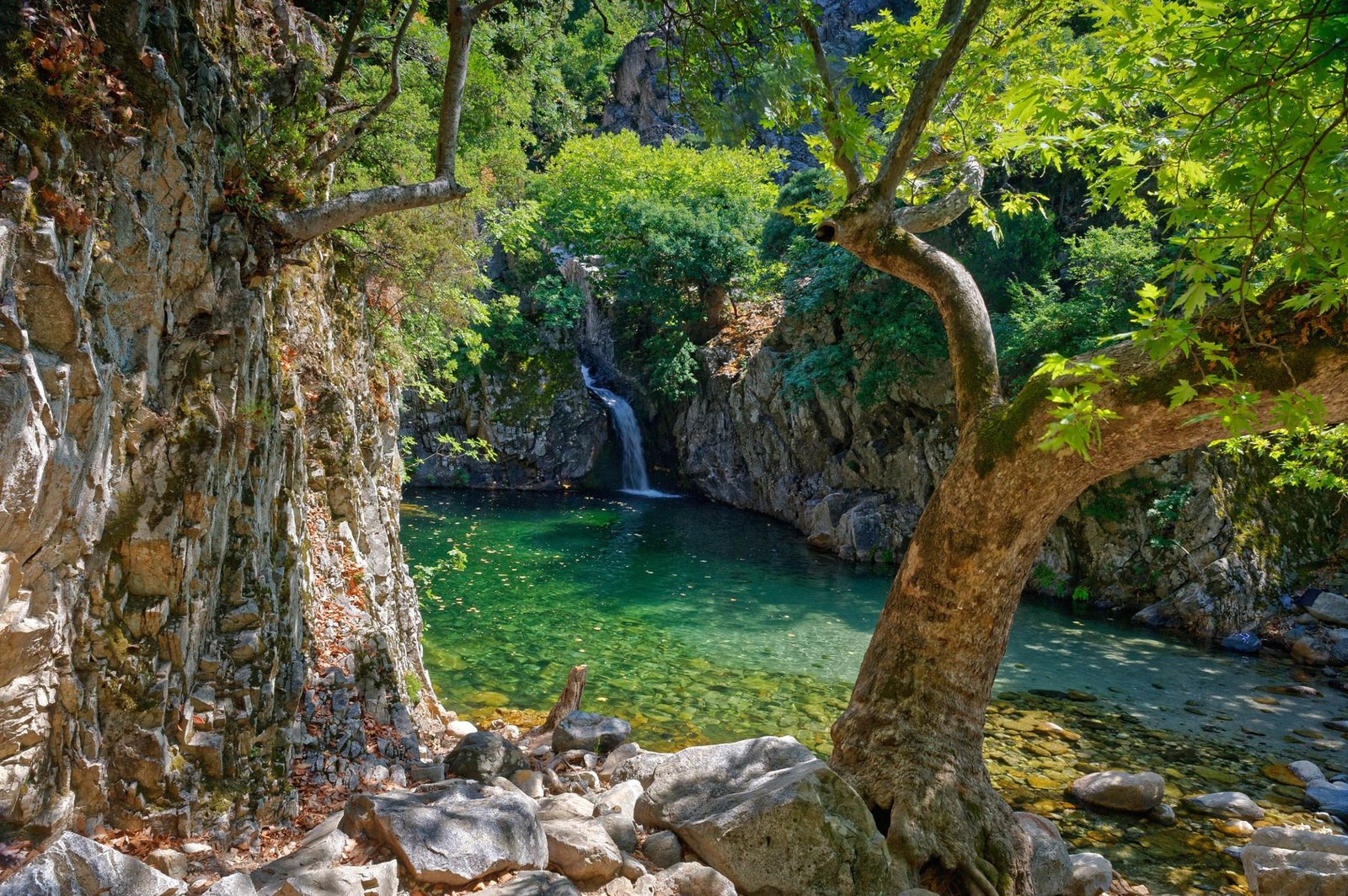
The Left Hand Path and Right Hand Path as terms in Western occultism are not metaphors borrowed loosely from general culture. They descend, through a long and tangled lineage, from exactly this fork in the Orphic underworld.
The current runs: Pythagoreanism (which absorbed significant Orphic material) → Neoplatonism → Gnosticism → Renaissance Hermeticism → the Rosicrucian tradition → the Hermetic Order of the Golden Dawn → Aleister Crowley and the Thelemic system. At each stage, the fundamental polarity — left as the path of matter, forgetting, and reincarnation; right as spirit, memory, and liberation — is transformed and partially obscured, but it never entirely disappears.
The Golden Dawn drew explicitly on Orphic and Eleusinian frameworks. Crowley, whatever else you want to say about him, was steeped in classical mystery cult material and knew exactly what he was doing with the terminology.
Which brings us to an important distinction.
Lévi and LaVey: The Costume and the Cosmology
Éliphas Lévi (Alphonse Louis Constant, 1810–1875) was a French ceremonial magician who essentially invented the visual vocabulary of modern Western occultism. The Baphomet image, the Sabbatic Goat, the inverted pentagram as a symbol of transgression — all Lévi. But here is the thing people consistently miss about Lévi: he was fundamentally a Christian esotericist. His system was about transcendence and the reconciliation of opposites. The Left Hand Path in his framework was a warning, a description of spiritual error, not a programme. His Baphomet is a symbol of balance — the resolution of above and below, male and female, light and dark — not an endorsement of diabolism.
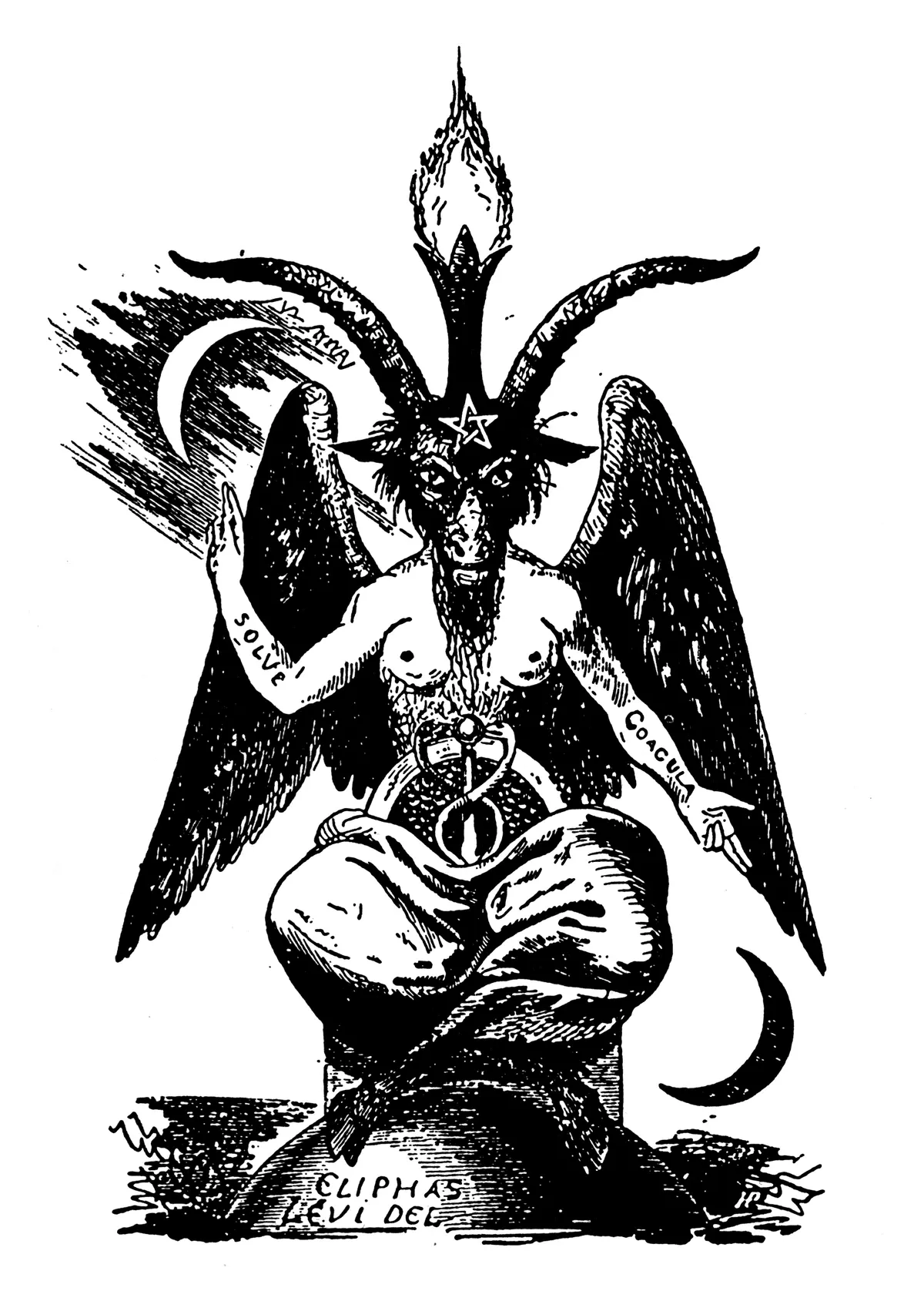
Anton LaVey (Howard Stanton Levey, 1930–1997) founded the Church of Satan in 1966 and wrote The Satanic Bible in 1969. He took Lévi’s iconography — the goat, the inverted pentagram, the whole theatrical apparatus — and rebranded the “wrong” path as the correct one. Self-deification, carnality, the sovereign ego. It was deliberately, gleefully transgressive and in many ways more a performance than a theology.
The deep irony is this: LaVey’s Left Hand Path, with its insistence on pure materiality and the rejection of any transcendent dimension, is actually much closer to drinking from Lethe than from anything the genuine left-hand-path traditions ever intended. It is the path of forgetting divine origin, of asserting purely material selfhood, of the common rout rushing toward the wrong spring because it’s right there and you’re thirsty.
The Orphic initiate standing at that fork in Hades is not a transgressor or a rebel. They are simply someone who remembered. That’s all. In the face of every pressure to forget — the sulphurous floods, the disorientation of death, the white cypress looking so inviting — they remembered who they were.
The password is not a magic formula. It is a statement of identity that has to be true when you say it.
The Purity of the Original
Strip away the centuries of accretion — the Renaissance hermeticism, the Victorian occult revival, the theatrical Satanism, the chaos magic, the internet aesthetics — and what you find at the source is remarkably clean.
A soul arrives at a fork in the road. It is parched. There are two springs. One will make it forget everything. One will let it remember.
It has been prepared. Not through secret passwords memorised by rote, but through a life — or multiple lives, the system implies — of genuine initiation: experience, suffering in the pathein sense, transformation. The gold tablet buried with the body is not the knowledge itself. It is a prompt. A reminder at the crucial moment for something the soul already knows, if it has done the work.
The guardians of Mnemosyne don’t give the water to everyone who asks. They give it to those for whom the declaration is true.
The Watcher
Here is what I want to leave you with, and it’s the thing that brought me to this poem at 1am in the first place.
The conscious mind can read everything. You can work through Graves, through the classical scholarship, through the history of the mystery cults, through the entire transmission from Orpheus to the Golden Dawn — and it remains information. Organised, useful, inert.
But the unconscious mind takes its own paths, and those paths are not always legible from the surface. What I’ve come to believe — and what the Orphic tradition would, I think, recognise — is that there is a watcher. Something that has absorbed all the maps and moves through the territory anyway, and knows, when it encounters a particular signpost, that this one matters. It doesn’t announce itself. It doesn’t explain its reasoning. It surfaces a poem at 1am and waits to see if you pay attention.
The ancient initiate at the fork in Hades wasn’t relying on their conscious recall of the tablet’s instructions. They were relying on something that had been laid down deeper — through ordeal and preparation and genuine transformation — and that would know the right spring when it felt the water.
The watcher and the guardians of Mnemosyne are doing the same job.
Pay attention to the signposts. Avoid the white cypress. Drink from the right spring.
Where to Find Graves
Complete Poems (Penguin, 2003) — edited by Beryl Graves and Dunstan Ward. The definitive collection. Instructions to the Orphic Adept is here.
The White Goddess (1948) — the theoretical framework for everything in this piece.
The Greek Myths (1955) — where he handles the Orphic and mystery cult material in prose. Controversial among classicists, essential for poets.
robertgraves.org — the Robert Graves Society, with bibliography and resources.
For the primary sources on the gold tablets: The Orphic Gold Tablets and Greek Religion by Fritz Graf and Sarah Iles Johnston (Cambridge, 2007) is the scholarly standard.
On other wheels
The wheel being referred to in the Orphic context is the Wheel of Necessity — Ananke’s wheel, or sometimes called the Wheel of Birth, the cycle of reincarnation itself. The Greek term is trochos (τροχός). The soul that drinks from Lethe forgets, reincarnates, lives, dies, forgets again, and the wheel keeps turning. Liberation means stepping off the wheel entirely, which is what drinking from Mnemosyne enables. Some tablets explicitly use the phrase “I have flown out of the sorrowful weary wheel.”
Hecate’s wheel — the strophalos — is a different symbol entirely. It’s the spiral or labyrinthine wheel associated with Hecate as goddess of crossroads, thresholds, and liminal magic. Interestingly Hecate is present in the Orphic underworld tradition as a guide figure, and she governs crossroads — which is thematically resonant with the fork in the road at the two springs — but her wheel is about her own power and the turning of magic, not the reincarnation cycle specifically.
The Wheel of Fate — the Moirai’s spindle and thread — is closer but still distinct. That’s about the duration and nature of a given life, not the cycling of lives themselves.
The overlap that causes confusion is that Hecate, the Moirai, and Ananke all operate in the same conceptual territory in Greek thought, and later traditions — particularly Neoplatonism and then Renaissance occultism — tended to blur these distinctions enthusiastically.
Post Script
I would be remiss leaving you with the thought that only the greeks thought about this. In Tibetan Buddhism there is the Wheel of Samsara (the Bhavachakra, literally “wheel of becoming”) and that’s probably the closest parallel to the wheel I mentioned above and it’s almost certainly drawing from a shared Indo-European root rather than being coincidental convergence. You might argue this is exactly the sort of sign post the watcher is quietly prompting us to pay attention too.
The Bhavachakra has the realms mapped onto it — gods, demi-gods, humans, animals, hungry ghosts, hell beings — and where you land on the next turn is determined by karma, attachment, and crucially by the state of mind at the moment of death. The Tibetan Book of the Dead (Bardo Thodol) is essentially the same technology as the Orphic gold tablets: instructions given in advance, to be activated at the threshold moment, so that the consciousness recognises what it’s encountering rather than reacting from confusion and fear and getting swept back into rebirth by default.
The structural parallel is almost exact:
Orphic: parched and disoriented soul faces two springs, needs prior preparation to choose correctly
Tibetan: consciousness in the bardo encounters lights and visions, needs prior preparation to recognise the clear light rather than flinching toward the dimmer, more familiar realms
Both systems say: the untrained consciousness will take the path of least resistance, which is the wrong one. The common rout rush to the black spring. The unprepared consciousness flees the brilliant clear light toward the softer bardos and reincarnates.
And both frame the solution identically — not willpower in the moment, but preparation laid down before the moment arrives, deep enough that it operates below conscious control.
This isn’t just the Greeks, it’s everyone that spends time reflecting on our true nature.