Half-truths do damage that outright lies cannot. A lie, when exposed, destroys the liar. A half-truth survives exposure because it was never technically wrong. It simply arranged things to point you toward a conclusion the evidence didn’t actually support.
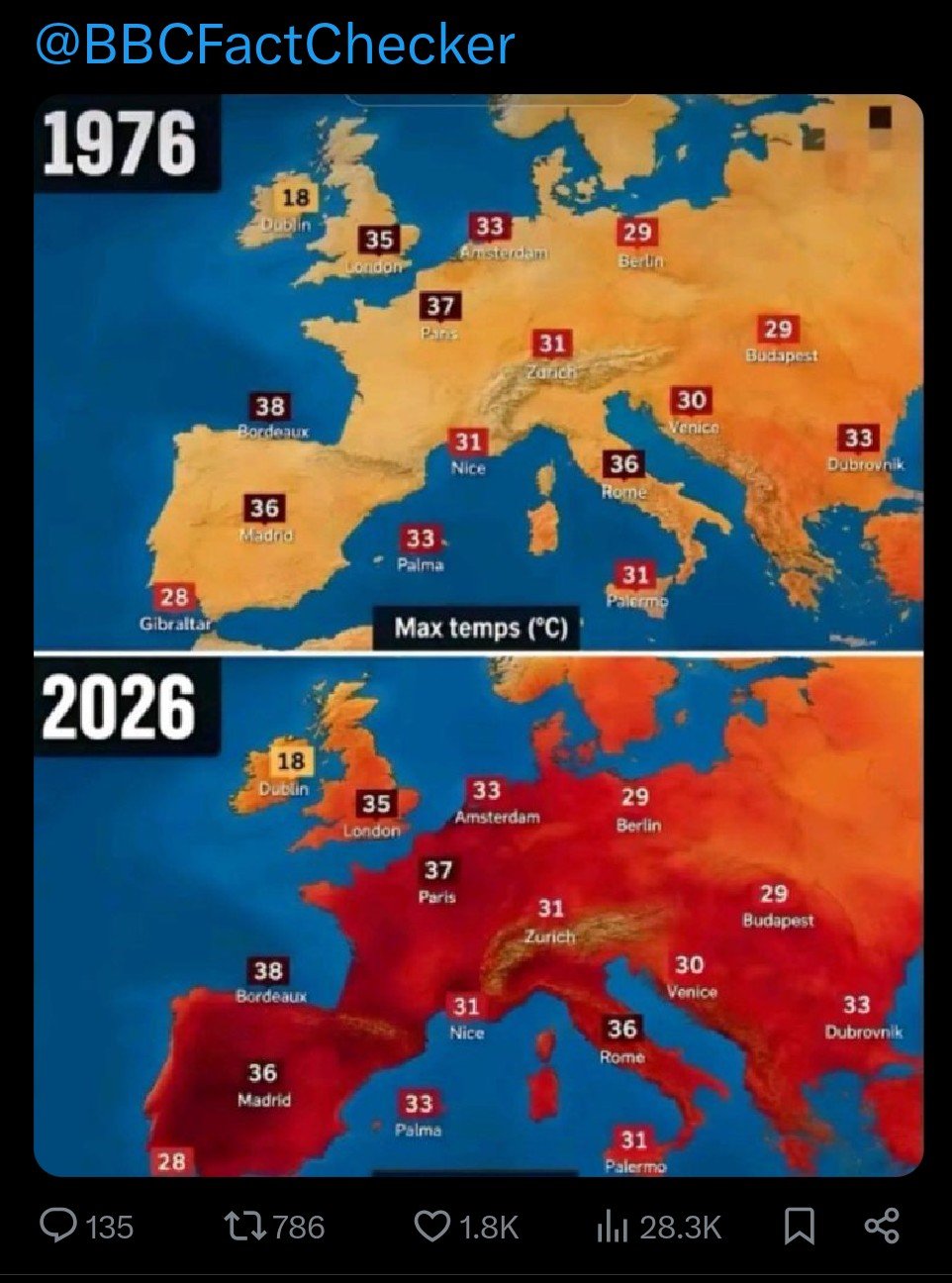
A screenshot circulating under the handle @BBCFactChecker — not an official BBC account — showing European temperature maps from 1976 and 2026 side by side. The temperatures on both maps are broadly similar. The 1976 map is rendered in warm ambers. The 2026 map is deep red.
The numbers are roughly accurate. 1976 was a genuine and punishing European heatwave. I remember it, but I also remember what weather maps looked like on TV in 1976 too. However our two maps are rendered in an identical modern GIS style that simply did not exist in 1976 — the 1976 map was retrofitted using contemporary software to make the comparison possible. More importantly, the colour scales are not equivalent. After the 2003 French heatwave, in which approximately 15,000 people died (really!!), meteorological agencies fundamentally redesigned their communication. The red was a policy decision born of mass death. It means danger, not just hot.
So the juxtaposition isn’t comparing 1976 to 2026. It’s comparing a 1976 temperature reading rendered in 2026 crisis-communication language against a 2026 temperature reading rendered in the same language, and then asking you to conclude that nothing has changed. You are being shown two things that look equivalent and told they are equivalent, when the entire communicative apparatus around them was redesigned precisely because one was catastrophic and the other wasn’t.
That is not a lie. That is something worse.
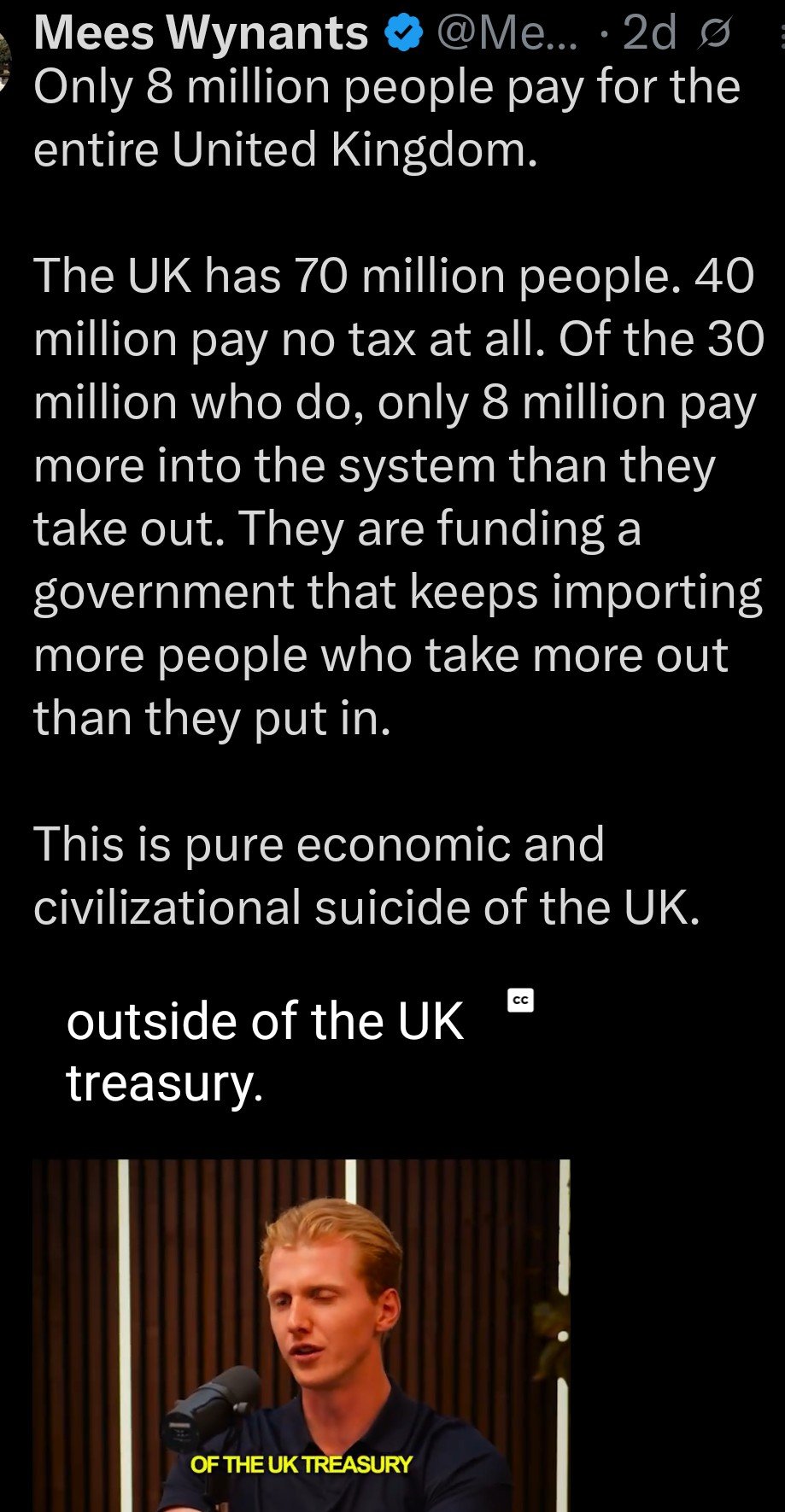
A post claiming that of the UK’s 70 million people, 40 million pay no tax at all, only 8 million are net contributors to the state, and that immigration is the mechanism driving this imbalance. Conclusion: “pure economic and civilizational suicide.”
The broad numbers are not fabricated. But when he says “pay no tax at all” he actually means income tax, erasing indirect taxes entirely, VAT, council tax, fuel duty, and National Insurance — are taxes that virtually everyone pays. The “net contributor” framing also collapses a lifetime welfare state into a snapshot, ignoring that the student who takes out now will pay in for forty years. And then, having established a genuine but distorted picture of fiscal stress, the post inserts immigration as the cause — a claim the numbers don’t support and weren’t designed to test.
The conclusion — civilizational suicide — was always the destination. The statistics were reverse-engineered to reach it.
Both posts will survive basic fact-checking. The temperatures are real. The tax figures are real. The BBC branding on the first is fake, but the underlying data isn’t. If you fact-check the facts, you find nothing to correct. The manipulation is structural, not factual.
This is where we are now. Mainstream media eroded its own credibility through decades of editorial capture, political pressure, and the slow subordination of truth-telling to access journalism. When it collapsed as a trusted authority, citizen journalism rushed in — and brought with it the naive assumption that pointing a camera without commentary is neutrality. It isn’t. The frame is always editorial. Where you stand, when you press record, whose face fills the shot — Hamas understood this before most Western journalists did.
The consequence of sustained institutional dishonesty is not a better-informed public. It is a public that has, reasonably and rationally, adopted a zero-trust epistemology. If no source can be trusted, you trust only what you have directly experienced. And there is something superficially healthy about that — the instinct that caught both posts above came from exactly that kind of earned scepticism (I’m a cynical bastard perhaps).
But consider what zero-trust epistemology means when it scales to society as a whole.
There are things almost none of us experience directly. Nuclear safety (something that has to work perfectly for at least 300 electoral cycles after a large power-station is decommissioned. Pension fund solvency (life time). Pandemic transmission dynamics (months). Climate systems (life times). These require you to trust someone’s instruments, someone’s methodology (Ed Milliband, give us a referendum on your Net Zero policies and see if you actually have a mandate from us). Then there are institutions we have to trust directly and experience often, the police, schooling and education systems, the local council, the judiciary.
A population that cannot extend that trust cannot make collective decisions about collective threats. Democratic legitimacy rests on a shared reality. You cannot vote meaningfully on what to do about something if you cannot agree on what is happening.
And then there is the harder consequence. The one nobody wants to say plainly, not least because in the UK you can get locked up for reasonable carefully worded posts of social media.
If you cannot trust institutions, you cannot trust that help will come when you need it. Worse: in a legal and social culture that has increasingly punished people for acting in their own defence, the zero-trust position reaches its logical terminus in a very dark place indeed. You are, on your own. You will not be helped. And if you act as though you are on your own, you will be punished for it.
A country where people have reached that conclusion — quietly, rationally, from accumulated evidence — is not a country in which anyone should feel comfortable. Not because those people are wrong to have reached it, but because the institutions that drove them there have not yet understood what they have destroyed.
We should be very clear about what is being done, and who benefits from doing it.
But here is what the anger obscures, and what almost nobody is saying clearly enough. Perhaps I am wrong in this but I feel like I am grieving.
What we are experiencing right now — the rage, the exhaustion, the sense that nothing can be believed — these are not signs of a problem that is about to be solved. They are the early stages of a loss that has already happened. Institutional trust, once broken at this scale, does not recover because institutions become trustworthy again. It does not recover when the right party wins an election, or when a better editor takes over, or when the algorithm is adjusted. Those things matter at the margins. They do not address the wound.
That’s a HUGE PROBLEM. Honestly it’s why we need capital punishment and treason back on the books because if destroying a societies trust isn’t treasonous I don’t know what is.
The research on post-conflict societies is uncomfortably instructive here. Societies emerging from civil war or revolution — genuine ruptures in collective trust — typically require two to three generations to rebuild measurable institutional confidence. That’s Sixty to ninety years, if things go well.
The Spain’s Civil War ended in 1939. Political scientists were still measuring distinctive patterns of low institutional trust and high interpersonal suspicion in the grandchildren of people who lived through it, well into the 2000s. The trauma transmits. It travels in stories told at kitchen tables, in reflexive suspicion that parents pass to children without meaning to, in the emotional weather of households that were shaped by betrayal. It’s carried in the genetics of children whose parents lived through civil war.
Rwanda is sometimes offered as a counter-example — relatively rapid institutional rebuilding after the 1994 genocide. But that recovery came with authoritarian consolidation. The trust was partly enforced. The fractures were suppressed, not resolved. You can do it faster, but there is usually a price, and the price is its own kind of damage.
Northern Ireland is perhaps the most useful example for British readers, precisely because it is — by the standards of the genre — a success story. The institutions have recovered substantially. Polling shows dramatically higher trust in devolved governance now than at the height of the Troubles. And yet interface communities still do not fully trust each other. Vertical trust — faith in institutions — can be rebuilt through competent and fair governance over decades. Horizontal trust — between citizens, between communities — recovers slower, if at all. The current immigration and policing issues in both the South and North of Ireland are incrementally destroying the peoples trust in those institutions. The governments are picking at a wound that hasn’t fully healed by doing that.
Frankly I think most of our politicians and civil servants are utterly insane, consumed by hubris and four year political cycles. They need to do better and immediately.
What this means is that we are not at the end of something. We are at the beginning of something very long. The generation currently in anger, and the anger is legitimate, it is the correct response to what has been done (as Reforms leader suggested), will not live to see the rebuilding completed. That is not despair. It is just honesty about the scale of what has been lost, and what it will take.
Grief has stages. Denial — it’s just fake news, algorithms, we’ll fix it with media literacy. Anger — where most of us are now, and where most political commentary wants us to stay, because angry people click and share and vote in predictable ways. What comes after anger is harder and less useful to those who profit from our outrage. It is the long slow work of deciding what we actually want to rebuild, and whether we are willing to do the unglamorous generational labour of rebuilding it.
The people engineering the half-truths are not thinking in generations. They are thinking in news cycles. That is, in the end, the only advantage we have.
[Author note: I’m really busy on other projects but felt I should write about this after spending 10 minutes on X]