For the Substack commenter who, whenever anyone criticises Islamist violence, pops up to say: “Hah, you think that’s bad? Look at what Christians did.”
You’re right. I did look. The numbers are in this article, and they’re worse than you probably think. Christians have been spectacular killers — of Muslims, of indigenous peoples, of each other.
But here’s what your argument actually is: a fallacy. It’s called tu quoque — “you also” — and it’s the rhetorical equivalent of a child caught hitting his sister who says “but she hit me last week.” It doesn’t work in the playground and it doesn’t work in geopolitics.
The crimes of my ancestors do not purchase silence about the crimes happening now. If they did, no one on Earth would be permitted to criticise anything, because every civilisation’s history is drenched in blood. The correct response to “Christians killed millions in colonial India” is not “therefore you can’t talk about ISIS.” It’s “yes, and that was also monstrous, and we should be honest about all of it.”
So let’s be honest about all of it.
An attempt to honestly tally the dead — by ideology and religion — across the last three centuries. All numbers are approximate, all attributions are contested, and the truth is worse than any of us would like to believe.
The Question Nobody Wants to Answer
Here’s a question that will lose you friends at dinner parties: which ideology or religion has killed the most people?
Ask a secular liberal and they’ll point at religion — probably Christianity, possibly Islam. Ask a conservative and they’ll say communism without hesitation. Ask a Muslim and they’ll note that the word “crusade” is still doing heavy rhetorical lifting a millennium after the fact. Ask a Hindu nationalist and they’ll give you a number for Islamic conquest that will make your eyes water.
They’re all partly right. They’re all missing the bigger picture.
What none of them tend to do is actually look at the data — all of it, across all categories, with the same methodology applied to each. Because the data is inconvenient for everyone. It turns out that no civilisation has clean hands, but some have dirtier hands than their defenders would like to admit, and the distribution of guilt doesn’t map neatly onto anyone’s preferred narrative.
I’ve spent time digging through the scholarly literature — Rummel’s Death by Government, Courtois’s Black Book of Communism, Davis’s work on colonial famines, the Aal al-Bayt Institute’s remarkable Body Count study — to try to assemble something approaching an honest reckoning. What follows is necessarily approximate. The margin of error on some of these figures is wider than the entire death toll of the Napoleonic Wars. But the patterns are clear enough to be worth examining.
Let me start with the finding that surprised me most.
Christians Have Been Extraordinarily Good at Killing Each Other
When you think of “Christian violence,” your mind probably goes to the Crusades, or colonial conquest, or the Inquisition. Those all feature in the ledger. But the striking pattern of the last three centuries is the sheer scale of Christians slaughtering other Christians.
The Thirty Years’ War (1618–48) — Catholics versus Protestants in the Holy Roman Empire — killed approximately 8 million people and reduced the population of some German regions by 60%. The French Wars of Religion killed 2–4 million. These were wars fought explicitly over theology, between people who read the same Bible and worshipped the same God.
Then came the wars that weren’t technically religious but were fought almost entirely between Christian nations: the Napoleonic Wars (3.5–6.5 million dead), the Crimean War, the Franco-Prussian War, and the two conflicts that define the modern era.
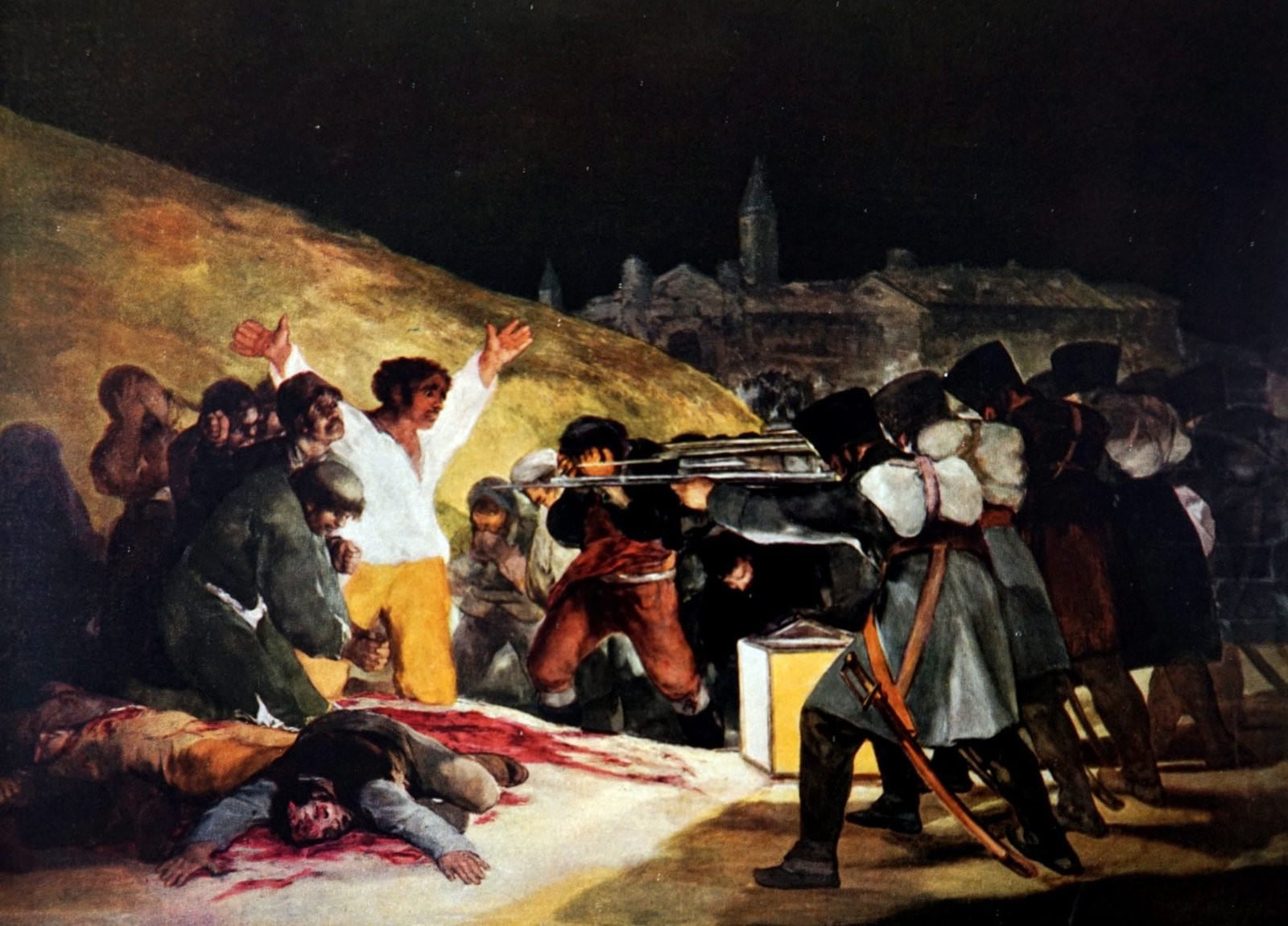
World War I killed 17–20 million people. Every major belligerent — Britain, France, Germany, Russia, Austria-Hungary, Italy, the Ottoman Empire’s Christian enemies — was a nominally Christian state. They marched to war with chaplains blessing the guns on both sides. The Christmas Truce of 1914, where soldiers from opposing trenches sang carols together before returning to killing each other the next morning, captures the absurdity perfectly.
World War II is harder to categorise — Nazi ideology was anti-Christian at its core despite emerging from a Christian society, and Imperial Japan was Shinto/Buddhist — so I’ve placed the bulk of it in a “Mixed/Contested” category. But if you attribute even half the European theatre to the Christian/Western column, the numbers are staggering.
The Colonial Ledger
The other major Christian/Western entry is colonialism, and here the numbers become genuinely enormous — and genuinely contested.
British India is the single largest item. Mike Davis’s Late Victorian Holocausts estimates 12–29 million deaths from famine in British India between 1876 and 1902 alone — famines that were substantially caused or exacerbated by colonial economic policy, grain exports continuing during starvation, and deliberate refusal of relief. Add the Bengal famine of 1770 (~10 million) and the Bengal famine of 1943 (~2–3 million), and you’re looking at perhaps 15–30 million dead from British colonial famines in India over two centuries.
The Congo Free State under Leopold II killed an estimated 10 million people between 1885 and 1908 — roughly half the population. This was one man’s personal colony, operated as a forced-labour extraction enterprise. Missionaries documented the atrocities. Hands were cut off workers who didn’t meet rubber quotas. Adam Hochschild’s King Leopold’s Ghost remains the definitive account.
The Atlantic slave trade continued into the 19th century. Patrick Manning estimates that about 12 million slaves entered the Atlantic trade, with roughly 1.5 million dying during the Middle Passage and another 4 million dying in Africa after capture. The trade was operated overwhelmingly by Christian European nations — Portugal, Britain, Spain, France, the Netherlands.
The conquest of the Americas had largely occurred before 1700, but its effects continued. Indigenous populations had collapsed by 90% from a pre-contact estimate of 56–145 million. While disease was the primary killer, warfare, forced labour, and deliberate starvation campaigns — including the systematic destruction of the bison herds on the American plains — continued well into the 19th century.
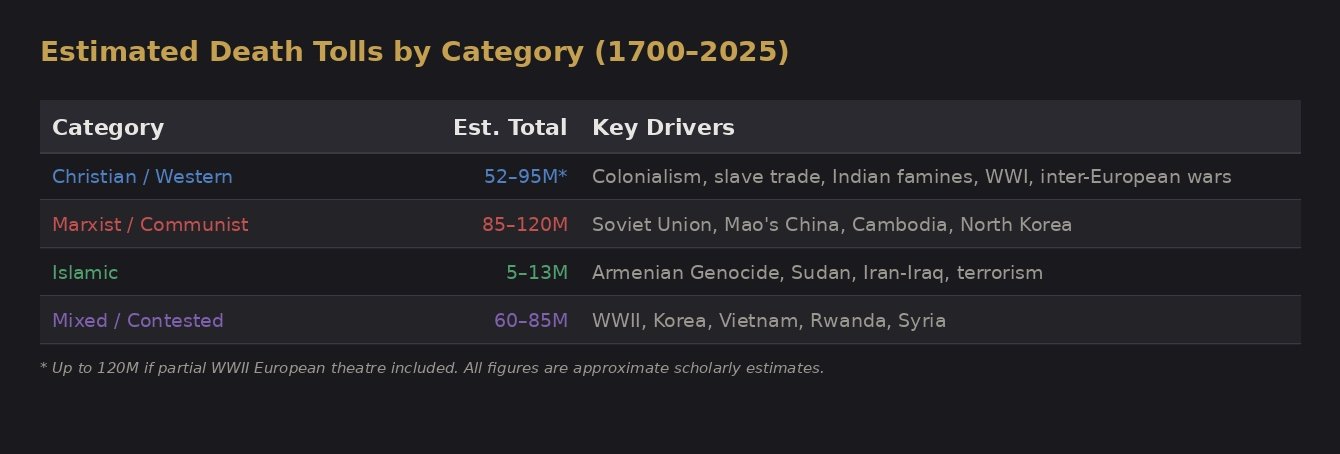
Add it all up, and the Christian/Western total for 1700–2025 comes to roughly 52–95 million, excluding WWII’s contested attribution. If you include a proportional share of WWII, the range extends to 75–120 million.
The Communist Compression
Marxism/Communism presents a different pattern: an extraordinary concentration of killing in a much shorter timeframe. Where Christian/colonial violence was spread across three centuries and multiple continents, communist violence was compressed into roughly 70 years (1917–1991) and dominated by two regimes.
The Soviet Union under Lenin and Stalin accounts for an estimated 20–61 million deaths, depending on methodology. The Holodomor (1932–33) killed 3.5–7.5 million Ukrainians through deliberate famine. The Great Purge executed 700,000–1.2 million. The Gulag system killed an estimated 1.5–6 million through forced labour. Stalin alone may have been responsible for 43 million deaths.
Mao’s China is the single deadliest entry in the entire ledger. The Great Leap Forward (1958–62) — a crash industrialisation and collectivisation programme — created a man-made famine that killed an estimated 30–45 million people. Most scholars place it around 36 million. This was followed by the Cultural Revolution (1966–76), which killed somewhere between 500,000 and 20 million through purges, factional violence, and persecution.
Cambodia under the Khmer Rouge (1975–79) killed approximately 1.5–2 million people — roughly 25% of the country’s population — through execution, forced labour, and starvation. Proportionally, this may be the single deadliest ideological regime in history.
Other communist regimes add to the toll: North Korea (1–3.5 million, including the 1990s famine), the Soviet-Afghan War (1–2 million Afghan dead), Ethiopia’s Red Terror and famine (0.5–1.5 million), and various smaller entries.
The total comes to roughly 85–120 million for the Marxist/Communist category. Courtois’s Black Book of Communism arrived at approximately 94 million. Rummel’s Death by Government produced higher figures. Archival revisionists argue for lower numbers. The scholarly consensus clusters around 85–100 million.
The Islamic Column Since 1700
The Islamic death toll since 1700 is markedly lower than the other two categories — roughly 5–13 million — but this requires context.
The major entries include the Armenian Genocide (1–1.5 million, though attribution is contested — the Young Turks were secular nationalists operating an Islamic state), the Sudanese Civil Wars (1.5–2 million), the Iran–Iraq War (0.5–1 million), the Bangladesh Liberation War (300,000–3 million, depending on source), and the ongoing conflicts in Yemen, Syria, and Darfur. Islamist terrorism worldwide since 2001 has killed an estimated 50,000–150,000 people.
The relatively low figure is not evidence that Islam is inherently less violent than Christianity or communism. It reflects the fact that since 1700, no Islamic state has possessed the industrial-military capacity to wage war on the scale of European colonial powers or communist superpowers. The Ottoman Empire was in decline throughout this period. The major Islamic states of the 20th century — Iran, Iraq, Saudi Arabia, Pakistan — were regional powers, not global ones.
Pre-1700 Islamic violence tells a very different story, which we’ll examine in Part 2.
The “Mixed/Contested” Problem
A responsible accounting requires a large “Mixed/Contested” category — roughly 60–85 million — because many of the deadliest conflicts resist neat ideological classification.
World War II (65–85 million total dead) is the obvious case. Nazi Germany emerged from Christendom but was anti-Christian in ideology. The Holocaust targeted Jews based on racial theory, not theology — though centuries of Christian antisemitism created the conditions. Imperial Japan was Shinto/Buddhist. The Soviet Union, fighting on the Allied side, was communist. There is no honest way to file this under a single heading.
The Korean War (2–3 million dead) was communist North versus US-backed South, with atrocities on both sides. Vietnam (1.5–3.8 million dead) was similar — a war that was simultaneously anti-colonial, nationalist, and ideological. The Rwandan genocide (800,000 dead) was ethnic, not religious — both Hutu and Tutsi were predominantly Christian, and some clergy participated in the killing.
The Dirty Secret: Every Ideology Eats Its Own
There’s a pattern hiding in the data that deserves its own heading, because it undermines every tribal narrative simultaneously: each ideology has been at least as lethal to its own adherents as to its enemies.
We’ve already seen the Christian case. The Thirty Years’ War, the French Wars of Religion, and World War I were overwhelmingly Christians killing Christians. But the Islamic and communist ledgers show exactly the same pattern.
The Iran–Iraq War (1980–88) killed 500,000 to a million people. Both sides were Islamic states — one a Shia theocracy, the other a Sunni-dominated Ba’athist republic. The Syrian Civil War has killed over 500,000, the majority of them Muslims killed by other Muslims. The Yemen Civil War — Houthi Shia versus a Saudi-led Sunni coalition — has killed an estimated 150,000 in combat and another 227,000 from indirect causes. The Algerian Civil War of the 1990s saw Islamist factions and the secular government kill 100,000–200,000 people in a country that was virtually 100% Muslim. The Arab Spring uprisings and their aftermaths — Libya, Egypt, Bahrain — added tens of thousands more. And this is just since 1700. The original Sunni–Shia split, the Fitna civil wars of early Islam, and the fratricidal collapse of the Abbasid Caliphate killed untold numbers more.
If you extend the lens to Islamic history, the Shia–Sunni divide has been producing corpses for 1,400 years with no sign of stopping. The Battle of Karbala in 680 AD — the event that crystallised the schism — set a template of intra-Islamic violence that the Iran–Iraq War and the ISIS campaign against Shia communities continued into the 21st century.
The communist pattern is equally stark. Stalin’s Great Purge targeted Communist Party members — true believers, many of them. The Sino-Soviet border clashes nearly brought two nuclear-armed communist states to war. Cambodia’s Khmer Rouge and Vietnam’s communist government fought a full-scale war in 1978–79. Trotsky was assassinated by a Stalinist agent. The entire history of 20th-century communism is a history of communists killing communists over doctrinal differences that, to an outsider, appear vanishingly small.
This matters because it demolishes the “clash of civilisations” framing that both Islamist extremists and Western hawks rely on. The data says the primary threat from any ideology is not to its civilisational rivals but to its own people. The Sunni farmer in Syria was more likely to be killed by another Muslim than by any crusader. The Ukrainian peasant was more likely to be starved by a fellow Soviet citizen than by any capitalist. The German Protestant was more likely to be killed by a German Catholic than by any Ottoman.
The enemy, it turns out, is rarely the stranger. It’s the neighbour who reads the same book but interprets it differently.
The Summary
What Does This Actually Tell Us?
Three things stand out.
First, the deadliest factor is not any particular ideology but the concentration of unchecked power combined with industrial capacity. Leopold’s Congo, Stalin’s Gulag, Mao’s Great Leap Forward, the British Raj’s famine policies — these are all cases of totalitarian or colonial administrations with the power to reshape entire populations and no accountability mechanism to stop them. The ideology shapes who gets killed and how the killing is justified, but the engine is always the same: absolute power plus the administrative capacity to deploy it at scale.
Second, every civilisational tradition has been complicit in mass killing, and the reflexive instinct to defend “our” side while condemning “theirs” is the most reliable indicator that someone hasn’t actually looked at the data. Christians pointing at communist death tolls should reckon with colonial India. Communists who dismiss the Gulag should look at Cambodia. Muslims who invoke the Crusades should examine Timur. Nobody’s hands are clean.
Third, the modern era is genuinely less violent per capita than the pre-industrial world — a point we’ll examine in detail in Part 2, where we go back before 1700 and discover that the Mongols, the Three Kingdoms, and the conquest of the Americas all killed a higher percentage of the world’s population than anything the 20th century produced. The absolute numbers went up because the population went up and the killing technology improved. But proportionally? We’re actually getting less murderous. Cold comfort, perhaps — but comfort nonetheless.
Part 2 will cover the pre-1700 era: the Mongol conquests, the Islamic expansion into India, the Crusades, the Barbary slave trade, and the Roman wars — with a per-capita analysis that reveals just how lethal the pre-industrial world really was.
Sources: Courtois et al., The Black Book of Communism (1997); Rummel, Death by Government (1994); Davis, Late Victorian Holocausts (2001); Hochschild, King Leopold’s Ghost (1998); Manning, Slavery and African Life (1990); Koch et al., Quaternary Science Reviews (2019); Aal al-Bayt Institute, Body Count (2009); White, The Great Big Book of Horrible Things (2012); Our World in Data; Wikipedia compiled sources cross-referenced against primary scholarship.
All figures are approximate scholarly estimates. This article does not claim moral equivalence between ideologies; it attempts an honest accounting of approximate death tolls. The author welcomes corrections from subject-matter specialists.