In Part 1, we tallied the dead since 1700 — roughly 200–300 million killed by Christian, communist, and Islamic states and movements. But the deeper you go into history, the more a disturbing pattern emerges: proportional to population, the pre-industrial world was often worse.
The Metric That Changes Everything
Here is a number that should stop you mid-sentence at that dinner party: the Mongol conquests killed approximately 40 million people when the world population was about 400 million. That is 10% of every human being alive on Earth.
To match that proportionally today, you would need to kill 800 million people.
World War II — the deadliest conflict in absolute terms — killed 70–85 million out of a global population of approximately 2.3 billion. That’s roughly 3%. The Mongols were three times worse, proportionally speaking, and they did it with horses and bows.
This is the insight that transforms the entire analysis. When we look at raw numbers, the 20th century appears uniquely murderous. When we look at percentages, we find that the ancient and medieval worlds were often far more lethal — not because people were more savage, but because smaller populations meant that the destruction of a single city or region could represent a significant fraction of the total human population.
The lesson isn’t that things were worse “back then.” It’s that the human capacity for organised violence has been remarkably consistent across millennia. What changed was scale, speed, and record-keeping.
The Barbary Slave Trade: The Forgotten Traffic
Before we get to the grand empires, let’s address the most under-discussed slave trade in popular history — one that ran in parallel with the Atlantic trade and in some periods exceeded it.
From roughly 1500 to 1830, North African corsairs — operating from bases in Algiers, Tunis, and Tripoli under the broad umbrella of the Ottoman Empire — raided European shipping and coastal towns from the Mediterranean to Iceland. Their purpose was straightforward: capturing Christians for sale as slaves in North Africa.
Robert Davis, a professor at Ohio State University, has calculated that between 1 million and 1.25 million European Christians were captured and enslaved in North Africa between the 16th and 18th centuries. At any given time, roughly 35,000 European slaves were held across the Barbary Coast. About 8,500 new captives had to be taken every year just to keep the slave population stable, given the death rate.
The raids were brazen. In 1544, the corsair Hayreddin Barbarossa captured the island of Ischia and took 4,000 prisoners. In 1551, the Ottoman corsair Dragut enslaved the entire population of the Maltese island of Gozo — between 5,000 and 6,000 men, women, and children. In 1631, corsairs raided the village of Baltimore on the southwest coast of Ireland at two o’clock in the morning, dragging 107 people from their beds and shipping them to Algiers. Some were ransomed. Most were never seen again.
Davis makes an important observation: from 1500 to 1650, when trans-Atlantic slaving was still in its infancy, more white Christian slaves were probably taken to Barbary than Black African slaves to the Americas. This doesn’t diminish the Atlantic trade, which grew vastly larger and more systematic. But it does demolish the assumption that slavery was exclusively a white-on-Black phenomenon. Both trades were monstrous. Both deserve acknowledgment.
The trade’s end is a story in itself. After American independence, US merchant ships lost the protection of the French and British navies. The Barbary states immediately began seizing American vessels and enslaving their crews. By 1800, tribute and ransom payments to North Africa consumed 20% of the entire United States federal budget. Twenty percent. The US Navy was founded in 1794 specifically to address this problem. The First Barbary War (1801–05) gave the Marines their hymn — “to the shores of Tripoli” — and the Second Barbary War in 1815 ended American tribute payments. An Anglo-Dutch bombardment of Algiers in 1816 forced a cessation of Christian enslavement, and France’s invasion of Algiers in 1830 finally ended the trade.
There’s a parallel trade that receives even less attention: the Crimean Tatar slave trade through the Black Sea. Between 1500 and 1700, Crimean Tatar raiders enslaved an estimated 1–2 million people from Russia and Poland-Lithuania, selling them into the Ottoman Empire and the broader Islamic world. Combined with the Barbary trade, the total Islamic slave trade in Europeans was likely 2–3.5 million over three centuries.
Meanwhile, the Arab slave trade in Africans — running via trans-Saharan and Indian Ocean routes — is estimated to have enslaved 12–17 million Africans over twelve centuries. The widespread practice of castrating male slaves contributed to the far smaller descendant population compared to the Atlantic trade, making this trade less visible in the modern world but no less horrific.
The Islamic Conquests: The India Problem
The pre-1700 Islamic death toll is dominated by one geographic entry, and it’s the most contested number in this entire analysis: the Islamic conquest of India.
Koenard Elst, in Negationism in India, gives an estimate of 80 million Hindus killed in the total jihad against India from roughly 1000 to 1500 CE. The mountains near India are called the Hindu Kush — Persian for “Hindu-killer.” Temples were systematically destroyed. Cities were sacked. Will Durant called it “the bloodiest story in history.”
But Elst’s number is the upper extreme, and it sits within a politically charged historiographical tradition. Hindu nationalist historians have strong motivations to emphasise the death toll; secular Indian historians and Islamic scholars argue it’s wildly inflated. More cautious estimates suggest 5–15 million killed directly over 500 years — still enormous, but an order of magnitude below Elst’s figure.
The truth is almost certainly somewhere between 5 and 40 million, and we will probably never know. Pre-modern India kept few reliable demographic records, and the conquests occurred over centuries across a vast subcontinent. What is not disputed is that the campaigns involved massive destruction of religious sites, widespread enslavement, and repeated large-scale massacres — Mahmud of Ghazni’s raids, the Delhi Sultanate’s campaigns, Timur’s sack of Delhi in 1398.
Timur (Tamerlane) deserves his own entry. Between 1370 and 1405, his armies are estimated to have killed approximately 5% of the world’s population across Asia, Africa, and Europe. He built towers of skulls at Baghdad, Delhi, and Tikrit. He explicitly framed his campaigns as jihad. The commonly cited figure of 17 million dead has been challenged by recent scholarship — the number may have originated from a chain of newspaper articles in the 1990s about Uzbekistan’s rehabilitation of Timur as a national hero, rather than from rigorous demographic analysis. A more defensible range is 7–12 million, which is still extraordinary for a pre-gunpowder conqueror.
The Ottoman conquests (1299–1683) were comparatively well-administered — the Ottoman Empire was a sophisticated state, not a raiding enterprise — but the conquests themselves were brutal. The Fall of Constantinople in 1453 involved rape, massacre, and the enslavement of the civilian population. The devshirme system forcibly took Christian boys from their families to be converted and trained as soldiers (the Janissaries). Total deaths attributable to Ottoman conquest are roughly estimated at 2–5 million.
The Crusades: Less Deadly Than You Think
The Crusades loom enormous in popular imagination but are surprisingly modest in the death toll tables. Scholarly estimates range from 1 million (Wertham) to 9 million (Robertson), with Matthew White’s geometric mean landing at about 3 million for the Crusades to the East (1095–1291).
Three million is a lot of people. But compare it to nearly every other entry in this analysis — it’s dwarfed by the Mongols (20–40 million), the conquest of the Americas (40–56 million), the Atlantic slave trade (12 million embarked, millions more dead), and most 20th-century conflicts. The Crusades killed roughly 0.3–1.4% of the world’s population over two centuries.
This doesn’t mean they weren’t horrific. The sack of Jerusalem in 1099, the sack of Constantinople in 1204 (Christians attacking Christians, no less), the Rhineland massacres of Jewish communities — these are among the most infamous atrocities in history. But in terms of sheer numbers, the Crusades are outweighed by conflicts that receive far less popular attention.
Where Christian violence before 1700 really accumulates is elsewhere:
The conquest of the Americas (1492–1700) produced the single largest demographic catastrophe in history. An estimated 56 million indigenous people died — roughly 90% of the pre-contact population and approximately 10% of the global population. Disease was the primary mechanism, but warfare, forced labour, slavery, and the deliberate destruction of food systems played enormous roles. The entire enterprise was explicitly justified as a Christian civilising mission.
The Thirty Years’ War (1618–48) killed 4–8 million people, reducing the population of the German lands by 20–40%. This was Catholics versus Protestants, Christians killing Christians over the correct interpretation of Christianity. Some regions lost 60% of their inhabitants — a proportion that exceeds anything in the 20th century outside of Cambodia.
The French Wars of Religion (1562–98) killed 2–4 million, including the St. Bartholomew’s Day Massacre of 1572, when Catholic mobs killed between 5,000 and 30,000 Huguenots in a matter of weeks. The French population declined by roughly 30% during this period, though climate and famine compounded the effect of warfare.
The Mongol Baseline
No analysis of pre-modern violence is complete without the Mongols, who serve as a useful baseline precisely because they defy neat religious or ideological categorisation (Genghis Khan was shamanist; his successors became variously Buddhist, Christian, and Muslim).
Between 1206 and 1405, the Mongol conquests killed an estimated 20–40 million people — roughly 5–10% of the world population. China’s recorded population dropped from approximately 120 million to 60 million. Baghdad, Merv, and Nishapur were effectively depopulated. The Mongols used terror as deliberate policy: if a city resisted, every inhabitant would be killed and towers built from their skulls as a warning to the next city.
To put 10% in modern terms: that would be 800 million people today. The equivalent of killing everyone in Europe.
The Per Capita Table
Here’s the comparison that crystallises the argument:
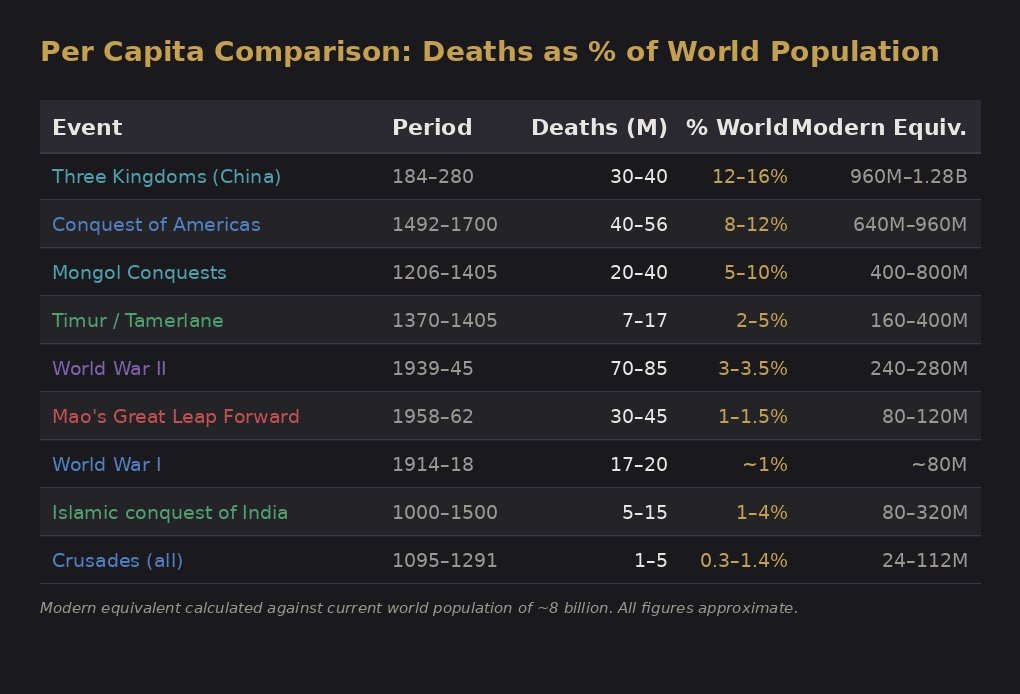
The Three Kingdoms war in China — which barely features in Western consciousness — was proportionally the deadliest conflict in recorded history, killing an estimated 12–16% of the world’s population. The Chinese census dropped from ~56 million to ~16 million over the course of the conflict. This dwarfs everything else on the list.
Pre-1700 Aggregate
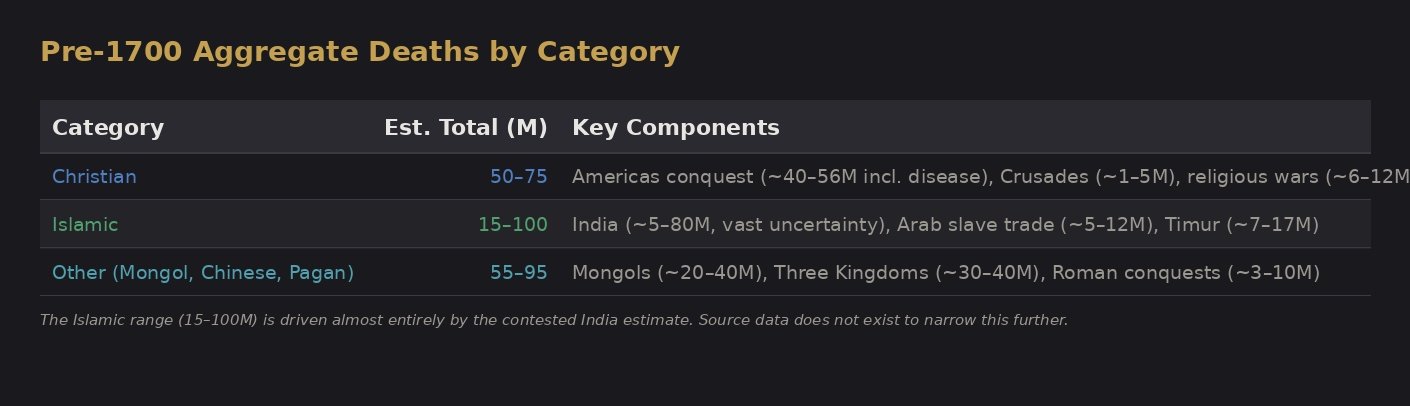
The Islamic range is almost comically wide — 15 to 100 million — because the India estimate dominates and varies by an order of magnitude depending on which historian you ask. This is not a gap that future research will easily close, because the source material simply doesn’t exist.
The Grand Total: What the Numbers Mean
Combining both parts of this analysis across all of recorded history, the rough totals are:
Christian/Western: 100–170 million across both pre- and post-1700 periods, dominated by the conquest of the Americas (pre-1700) and colonialism plus inter-European warfare (post-1700). The single most striking pattern is how much of this violence was directed at other Christians or at populations who posed no military threat.
Marxist/Communist: 85–120 million, concentrated almost entirely in the 20th century. The most compressed burst of ideological killing in history — more people killed per year of communist rule than per year of any other system.
Islamic: 20–113 million across all periods, with the vast uncertainty driven entirely by the India question. At the lower end, this is comparable to the Mongols. At the upper end, it rivals Christianity. The Barbary and Arab slave trades, largely forgotten in popular discourse, add millions more to the tally. The relative decline in Islamic violence after 1700 reflects the military decline of Islamic states, not any change in ideological disposition.
Other (Mongol, Chinese, Pagan): 55–95 million. A reminder that you don’t need an Abrahamic religion or a 19th-century political philosophy to kill enormous numbers of people. You just need power, opportunity, and a sufficiently dehumanised enemy.
Three Conclusions
First: No civilisation, religion, or ideology has a monopoly on mass violence. Anyone who tells you otherwise is selling something — probably their own civilisation’s innocence.
Second: The pre-industrial world was proportionally more violent than the modern world. Steven Pinker’s thesis in The Better Angels of Our Nature — that violence has declined over time as a percentage of population — is broadly supported by this data, uncomfortable as that may be for those who see modernity as uniquely brutal. We kill more people in absolute terms because there are more of us and our weapons are better. But the rate of killing has generally fallen.
Third: The deadliest variable across all eras is not ideology but the concentration of unchecked power. Whether it’s a Mongol khan, a colonial governor, a communist general secretary, or an Ottoman sultan, the pattern is the same: give one person or faction absolute authority over a population, remove all accountability mechanisms, and the killing follows with remarkable consistency. The ideology determines the target selection — kulaks, infidels, natives, heretics — but the underlying dynamic is structural, not doctrinal.
The 20th century’s unique contribution was not inventing mass violence but industrialising it. Gas chambers, collectivisation at gunpoint, aerial bombardment, nuclear weapons — these allowed states to kill at a tempo and scale that pre-modern logistics couldn’t match, even when pre-modern rulers were proportionally more destructive. What the 21st century has added, tentatively, is a set of constraints — international law, nuclear deterrence, democratic accountability, global media — that appear to be reducing the rate of killing, though whether this trend will hold remains the defining question of our era.
The dead, at least, deserve to be counted honestly. All of them.
A Final Word for the Straw Man
So, to the commenter who started this: you were right that Christian history is bloodier than most Christians want to acknowledge. The colonial famines, the Congo, the slave trade, the religious wars — it’s all there, and it’s horrifying.
But you were using that truth as a shield, not a lens. You weren’t saying “let’s be honest about Christian violence” — you were saying “therefore shut up about Islamist violence.” And that’s not history. That’s debate tactics.
The correct position is not complicated. It goes like this: the Crusades were bad. The colonial famines were bad. The Gulag was bad. The Great Leap Forward was bad. ISIS was bad. The Barbary slave trade was bad. The Atlantic slave trade was bad. Timur was bad. Leopold was bad. All of these things can be true simultaneously, and acknowledging any one of them does not require silence about the others.
The impulse to say “but your lot were worse” is not moral seriousness. It’s competitive victimhood dressed up as historical awareness. And the dead — all 200–400 million of them across these pages — deserve better than to be used as ammunition in an internet argument.
Count the bodies. All of them. Then ask what we do differently.
Sources: Courtois et al., The Black Book of Communism (1997); Rummel, Death by Government (1994); Davis, R.C., Christian Slaves, Muslim Masters (2003); Davis, M., Late Victorian Holocausts (2001); Hochschild, King Leopold’s Ghost (1998); Manning, Slavery and African Life (1990); Elst, Negationism in India (2002); Koch et al., Quaternary Science Reviews (2019); White, The Great Big Book of Horrible Things (2012); Aal al-Bayt Institute, Body Count (2009); Holt, compiled Crusade death estimates (2019); McEvedy & Jones, Atlas of World Population History (1978); Our World in Data; Wikipedia compiled sources cross-referenced against primary scholarship.
All figures are approximate scholarly estimates with wide uncertainty bands. Pre-modern population and casualty data should be treated with particular caution. This article does not claim moral equivalence between ideologies; it attempts an honest accounting of approximate death tolls.