Looking at the Angela Eagle interview on water industry reform I got fed-up.
I’ve thought about these problems for a long time as I like Stand Up Paddle boarding and river swimming but haven’t been able to go in my local rivers or the sea for the last 3 years due to the random water quality and not wanting to come back with Hepatitis.
Darren Grimes posted about it too over here:
You pay the bills. They dump the sewage. Labour offers you “a voice”.
Minister Angela Eagle is asked what actual powers people will get over water companies. Watch her try to name a single one.
They’ve had over two years to work on this.
So I dug out my old notes. I had designed a water storage system that looked at the long range forecast and dumped water in the days before a rain ‘event’ to prepare capacity for collection. I mean it’s just a WiFi connected valve with some software to look at the weather and dump water if needed.
Anyway I then sat down and chatted to Claude for all of 15 minutes and we came up with this.
Summary
Two hard targets:
Cut untreated sewage discharges in England by 80% by 2040,
Hold average household bills to no more than CPI + 2% a year from 2027.
The package does this by taking failing companies into public ownership through honest accounting, financing the work with very long public debt instead of 4% private capital, and paying households to hold back rainwater.
Targets
Discharges: 80% fewer storm-overflow spill hours than 2024 (3.6 million hours), measured weather-adjusted, by 2040. Zero dry-weather spills by 2030.
Bills: average bill (£639 in 2026/27) rises by no more than CPI + 2% in any year. Social tariff protected.
Five pillars
Honest accounts. Unfunded maintenance becomes a balance-sheet liability. Companies that can’t cover it recapitalise or go into special administration and pass to a public water corporation (at no cost to the tax payer other than having to manage it).
Cheap, long money. A ring-fenced public water corporation borrows on 50–100 year bonds at roughly government rates.
Targeted delivery. Storage, smart network control and sewer repair first; full sewer separation only where nothing else works.
Public run-off. Discounts for households and businesses that keep approved spare rainwater capacity ahead of storms.
Accountability. A weather-adjusted target, live spill data, and personal liability for dry-day spills.
England for spills; England and Wales for bills (Wales’s Dŵr Cymru is already not-for-profit; Scottish Water is already public).
Where we are now
Spills fell sharply in 2025, but mostly because it was a drought year — the underlying system has not changed much.
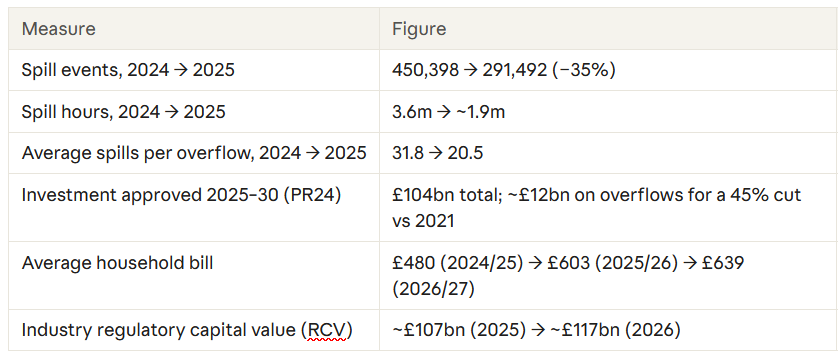
Sources in order of entry above;
The policy backdrop:
Regulator: the government accepted the Cunliffe review, and Ofwat is to be replaced by a single regulator; the January 2026 White Paper set this out, with the new body not expected before 2027 (Gowling WLG).
Thames Water: reported in August 2026 that the government had shelved special administration, with Thames estimating about £2bn of taxpayer support over 18 months (Reuters via ARY).
Price of ownership: Defra prices full nationalisation at about £100bn using RCV; critics argue the market value of stressed companies is far lower (Defra; Dieter Helm).
The 2026/27 rise of 5.4% was already roughly CPI + 2%, so the bill cap in this plan is tight but not fanciful.
Pillar 1: Honest accounts and public takeover
Make companies book the maintenance they have skipped as a debt; those that cannot cover it are recapitalised by investors or taken into public hands at a price that reflects the liability.
Asset-health audit (year 1). The new regulator commissions an independent condition survey of every company’s sewers, pumping stations and treatment works. The gap between actual condition and a statutory minimum standard is the company’s maintenance deficit.
Put it on the balance sheet. Legislation requires the maintenance deficit to be recognised as a regulatory liability in the company’s statutory and regulatory accounts. (Normal accounting standards don’t treat skipped maintenance as a liability, so this needs primary legislation, not just a rule change.)
Solvency test. Any company whose net assets go negative on this basis has 12 months to raise new equity — not debt — to close the gap. No dividends while the deficit stands.
Special administration if it can’t. A water company can’t be wound up like an ordinary firm, but the Water Industry Act 1991 already provides a Special Administration Regime. The regulator applies; the administrator keeps services running and transfers the business to a new public water corporation.
Price paid. Compensation is set by statute at RCV minus the maintenance deficit and any unpaid fines, and the result is shared among creditors by seniority. Shareholders likely get nothing; senior bondholders take a haircut rather than a wipe-out.
Companies that pass stay private but face the same targets, the same bill cap and an obligation to clear their deficit within 10 years.
The new public corporation is a legally separate body (like Scottish Water), with its own board, borrowing outside annual Treasury spending limits, and a duty to reinvest all surplus.
Pillar 2: Cheap, long money
Sewers last a century, so finance them over a century: a long public bond roughly halves the yearly cost of each £ invested compared with today’s private financing.
Water Infrastructure Bond. The Treasury’s debt office issues a dedicated index-linked bond series for the public water corporation, with maturities of 50 years and, if the market will take it, 100 years. (The UK’s longest gilt today runs to the 2070s; Austria sold a 100-year bond in 2017.) Proceeds are ring-fenced for capital works.
Refinance acquired debt. Expensive company debt taken over in Pillar 1 — some of it at close to 10% — is refinanced on public terms as it falls due.
Repay from bills, not taxes. Interest and principal are serviced from customer revenue, so the borrowing is self-funding. The Treasury guarantees but doesn’t subsidise.
Private companies get access too. Firms that stay private can borrow from a public water infrastructure bank at gilt + a small margin, in return for a capped equity return and no dividends while a deficit stands.
Bill cap in law. The average bill may rise by no more than CPI + 2% a year. Any shortfall is met by stretching the repayment term, not by bigger bills.
Why it saves money (approximate): today’s allowed real return on capital is about 4%; long index-linked public debt costs roughly 1.5–2% real. On a £117bn asset base, 2 percentage points is about £2.3bn a year.
Pillar 3: What the money buys
An 80% cut goes beyond the current 2050 plan (no overflow above about 10 spills a year), so the work starts with cheap capacity gains and keeps costly full separation for last.
Stop dry-day spills first (by 2030). These are blockages, failed pumps and undersized works, not storms. They are cheap to fix and already illegal.
Smart network control. Sensors and automated gates let sewers use their spare storage during storms. This is low-cost and quick to install.
Seal the pipes. Groundwater leaking into old sewers takes up storm capacity. Relining is cheaper than building new storage.
Storage tanks and tunnels. Hold storm flow until treatment works can take it. The Thames Tideway tunnel is the model for the biggest catchments.
Treatment-works capacity. Raise the flow each works must fully treat before it is allowed to overflow.
Green infrastructure. Swales, rain gardens and permeable paving keep rainwater out of sewers to begin with (see Pillar 4).
Separation as a last resort. Separate the foul and surface-water sewers only in the worst catchments. Full national separation has been costed in the hundreds of billions (approximate), so it is ruled out as a blanket policy.
Priority order: bathing waters, shellfish waters and chalk streams first, then everything else ranked by ecological harm per £.
Pillar 4: Let the public help with run-off
Pay people to keep rainwater out of the sewer in a storm. The key word is spare: a full water butt does nothing when the storm arrives.
Approved storage, kept empty for storms. A council tax discount (suggested £50–£100 a year) for homes with certified rainwater storage that holds back roof run-off in heavy rain. To qualify, a system must either drain slowly between storms or empty itself automatically before forecast heavy rain.
The water company pays for it. The sewer operator is the one that saves money, so it reimburses councils for the discount. A matching cut to the surface-water drainage charge on the water bill would be simpler for people to understand. Both routes should be offered.
Light-touch checks. Installers register each system and send a photo. A smart system can report itself. A small sample get spot checks.
Bigger roofs, bigger rewards. Schools, supermarkets, warehouses and car parks get rate relief or a drainage-charge cut for each cubic metre of attenuation they provide.
De-paving grants. Grants to turn paved front gardens back into permeable ground. Enforce the existing rule that paving over 5 m² of a front garden with non-permeable material needs planning permission.
New builds connect last. Fully commence the sustainable-drainage requirements of the Flood and Water Management Act 2010, so that new development can join the sewer only after on-site drainage is approved.
This pillar matters more for public involvement than for volume. Its main value is in dense urban catchments, where every cubic metre kept out of the sewer delays an overflow.
Pillar 5: Regulation and accountability
Measure the right thing, publish it live, and make individuals answerable.
Weather-adjusted target. Measure spill hours per unit of rainfall in each catchment, so that a dry year like 2025 can’t be counted as progress and a wet year doesn’t excuse failure.
Live public data. Every overflow already has a monitor. Publish its readings within the hour on a single national map, with each company’s performance against its glide path.
Dry-day spills are a personal offence. Directors are personally liable for unpermitted dry-weather discharges, with no bonuses in any year one happens.
One regulator, one plan. The new single regulator sets a 15-year catchment plan for each region, rather than five-year price reviews that encourage short-term thinking.
Annual report to Parliament on spill hours, the maintenance deficit, bill changes against CPI + 2%, and the cost of debt.
Does it add up?
On rough numbers it does, but only because of the switch to cheap, long finance. Funded with today’s private capital, the same work would use up almost all the room under the CPI + 2% cap.
Annual figures by the mid-2030s, in 2026 prices. These are my estimates, not sourced figures:
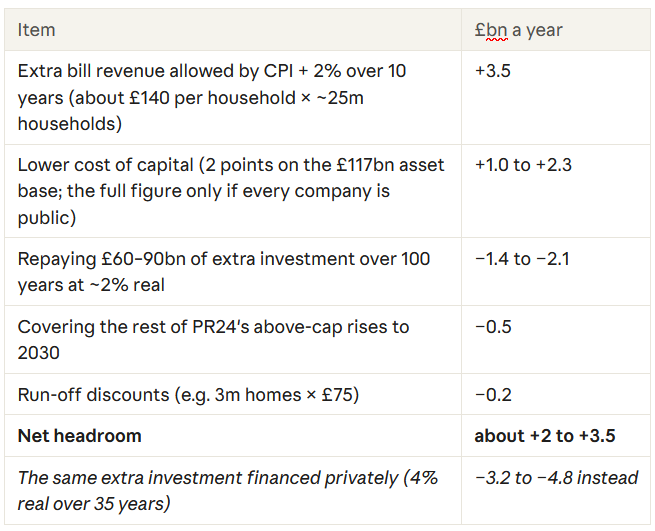
The headroom has to cover rising operating costs and paying down the maintenance deficit.
Main open question: nobody knows the size of the maintenance deficit until the Pillar 1 audit is done. If it turns out to be very large, the 2040 date slips, not the bill cap.
Risks and the case against
The strongest objections are about the cost of capital for the rest of the economy and about delivery, not about the targets themselves.
Expropriation risk. Changing the accounting rules so that companies become insolvent will look to investors like confiscation by another name. Expect a legal challenge under the human-rights protection for property (A1P1); Thames’s creditors have already hired litigators. The bigger cost may be indirect: higher borrowing costs for other UK regulated infrastructure such as energy networks.
Fiscal rules. The OBR estimated that bringing the water companies onto the public balance sheet could add about £78bn to public sector net financial liabilities (Commons Library via Water Magazine). The fiscal rules may need a carve-out for self-funding utility debt.
The 1980s argument. Supporters of privatisation point out that the pre-1989 public water authorities were starved of investment by Treasury spending controls. The ring-fenced corporation and bill-funded borrowing are meant to prevent that, but future governments could undo them.
The century bond market is thin. Long bonds lose a lot of value when interest rates rise (Austria’s 100-year bond lost about half its value after 2021 — approximate). A 50-year index-linked series is the safer fallback.
Burden on future generations. Spreading repayment over 100 years puts some of the cost on future bill-payers. That is defensible for 100-year assets and hard to defend for anything shorter.
Delivery capacity. Contractors, engineers and supply chains are already stretched by the £104bn programme. Speeding up may push prices up rather than output.
Weather. Climate change brings heavier downpours. A weather-adjusted target keeps the measurement honest, but the physical task keeps getting bigger.
Why do it anyway: the current model has raised bills sharply while leaving one major company close to insolvency. Cheaper long-term finance is the one lever big enough to pay for an 80% cut within an inflation-linked cap, and, well, you know, I like SUP boarding and river swimming….